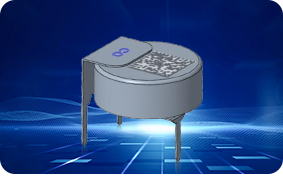
As of 2026, Ontario, Canada has officially implemented one of the strictest and most industry focused mandatory installation regulations for residential carbon monoxide (CO) alarms worldwide. With the official implementation of the new Ontario Fire Code, the North American residential safety market is ushering in a new round of structural growth opportunities.
Ontario province fully upgrades residential CO alarm requirements
According to the latest regulations, CO alarms must be installed in any of the following situations in residential buildings:
Equipped with combustion equipment or appliances
Equipped with fireplace system
Equipped with an attached garage
Heating system provided by external combustion equipment
Starting from January 1, 2026, regulations will be further upgraded to require:
CO alarms must be installed on every floor of the relevant residential buildings, including basement and non bedroom floors, and alarm devices must be installed near each sleeping area to achieve more comprehensive residential safety protection.
The scope of this regulatory upgrade has been further expanded from traditional independent residences to:
Apartments and multi unit residences
Condominium
Hotels and motels
retirement community
Care Occupancy
Among them, nursing facilities have been officially included in the mandatory installation scope for the first time, reflecting the continuous improvement of Canada's requirements for the life safety of special populations.

Saskatchewan province simultaneously promotes mandatory regulations
On May 5, 2026, the Saskatchewan government officially signed and implemented the "Henry's Law" in memory of the 11 year old boy Henry Losco, who tragically passed away in a carbon monoxide leak accident at his residence.
This regulation requires:
Starting from November 1, 2026, all independent residential units in multi unit residential buildings must be equipped with CO alarms, regardless of the building's age.
The industry generally believes that this marks the gradual transition of Canada's residential CO alarm regulations from "partial mandatory" to "comprehensive coverage".
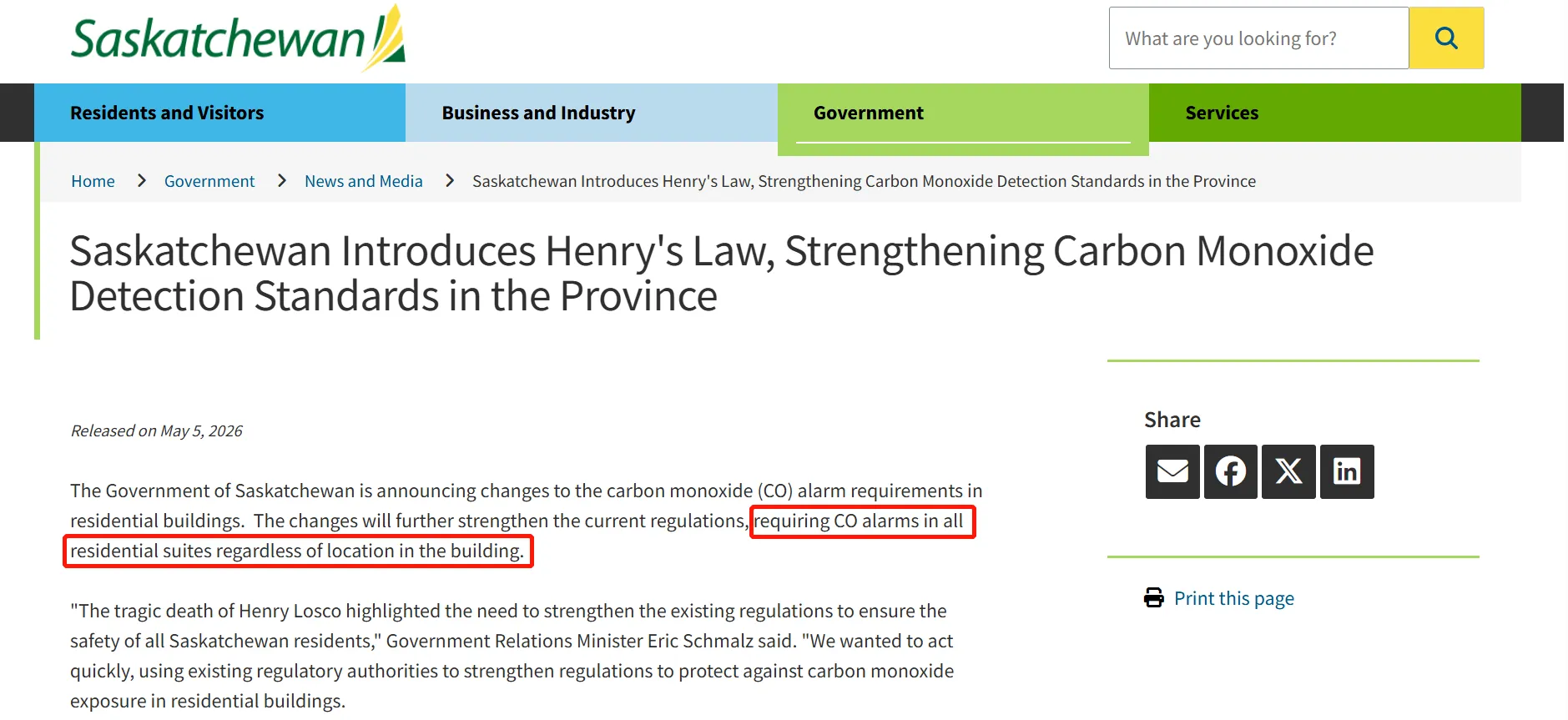
Source: Saskatchewan Introduces Henry's Law, Strengthening Carbon Monoxide Detection Standards in the Province | News and Media | Government of Saskatchewan
The North American residential safety market enters an incremental cycle
As of 2025, the total population of Ontario is approximately 16.26 million, accounting for approximately 39% of Canada's national population. Based on the scale of approximately 5.5 to 6 million residential units in Ontario and the implementation requirements of the new regulations, the industry generally expects:
This round of regulatory upgrades will form one of the largest incremental markets for residential CO alarms in North America in recent years.
The main sources of market growth include:
Existing residential buildings upgraded from single point deployment to multi floor coverage
Multi unit residential buildings add comprehensive coverage demand
Mandatory installation of new facilities in hotels, nursing homes, and nursing homes
Old alarm systems enter centralized replacement cycle
The demand for accessible and audio-visual products is increasing
It is expected that the market demand for new and replacement CO alarms in Ontario will be approximately 8 million to 15 million units (incremental demand) between 2026 and 2028.
Continuous upgrading of product structure
With the increasing regulatory requirements, the market's attention to product performance, interconnectivity, and long-term reliability continues to grow. The current mainstream product types include:
Sound only alarm type
Adopting high decibel buzzer alarm method, suitable for conventional residential and rental scenarios.
Sound and light alarm type (Visual&Sound/Strobe)
The demand for integrated audio and visual products with visual flashing prompts is rapidly increasing for applications targeting the hearing-impaired and special populations.
Combination Smoke+CO Alarm
Integrating smoke alarm and CO alarm functions can effectively improve installation efficiency and space utilization, and is becoming an important development direction in the residential market.
Different from the EU's management mechanism dominated by regulations and market access, the North American market relies on a mature legal liability system and insurance mechanism, and puts forward higher requirements for the safety, reliability, full lifecycle quality management, and traceability of CO alarm products.
For manufacturers, establishing a systematic and rigorous product development process, as well as a risk management system covering design, validation, change, and on-site quality feedback, is the key to reducing product liability and commercial risks.
Among them, the selection and verification of CO sensors are regarded as the core foundation of overall reliability, especially focusing on wide temperature range performance, long-term stability, resistance to silicon poisoning, and anti-interference performance in complex environments, to ensure the consistency and reliability of the product in long-term practical applications.
Compliance supervision continues to strengthen
According to the requirements of the Fire Protection and Prevention Act, the fire department has the authority to conduct inspections, issue rectification orders, and impose enforcement penalties.
The commonly used penalty standards in the industry include:
The maximum personal fine can reach CAD 50000
The maximum fine for enterprises can reach CAD 500000
Serious violations may involve further legal liability
With the continuous upgrading of regulations and strengthened enforcement, the residential safety product market is accelerating towards high reliability, high compliance, and long-term stable operation.
Industry Observation
The 2026 upgrade of residential CO alarm regulations in Ontario, Canada is widely regarded by the industry as the most influential mandatory CO detection upgrade in Canadian residential safety regulations in nearly a decade. ”
At the same time, this trend is expected to further promote the continuous strengthening of residential CO safety regulations in North America and more regions around the world, and bring long-term market opportunities for high-performance CO detection technology and alarm products.
FC-CO-5000 and FCW-CO-5000-0X: A unified sensing platform for multi scenario applications
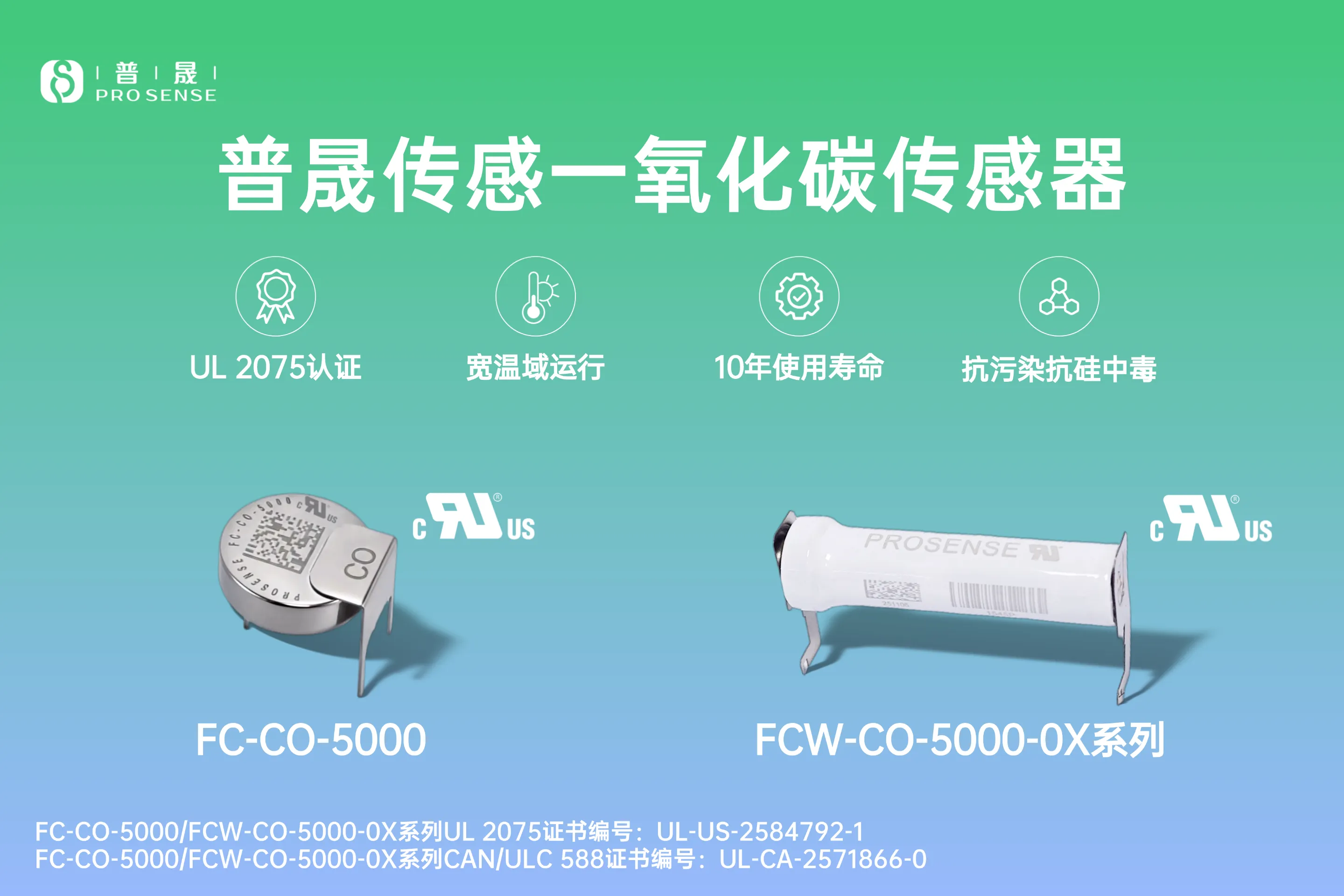
ProSense has launched the FC-CO-5000 and FCW-CO-5000-0X series carbon monoxide sensors based on its independently developed gas sensing technology platform. This series of products is designed for global market application needs and is currently the only unified CO sensor solution in the industry that can support certification requirements for multiple application scenarios for residential, RV, and yacht use in both the European Union and North America.
By designing a unified sensing platform, whole machine manufacturers can build a product portfolio covering multiple regional markets on a single hardware architecture, thereby reducing the research and maintenance complexity caused by platform differentiation.
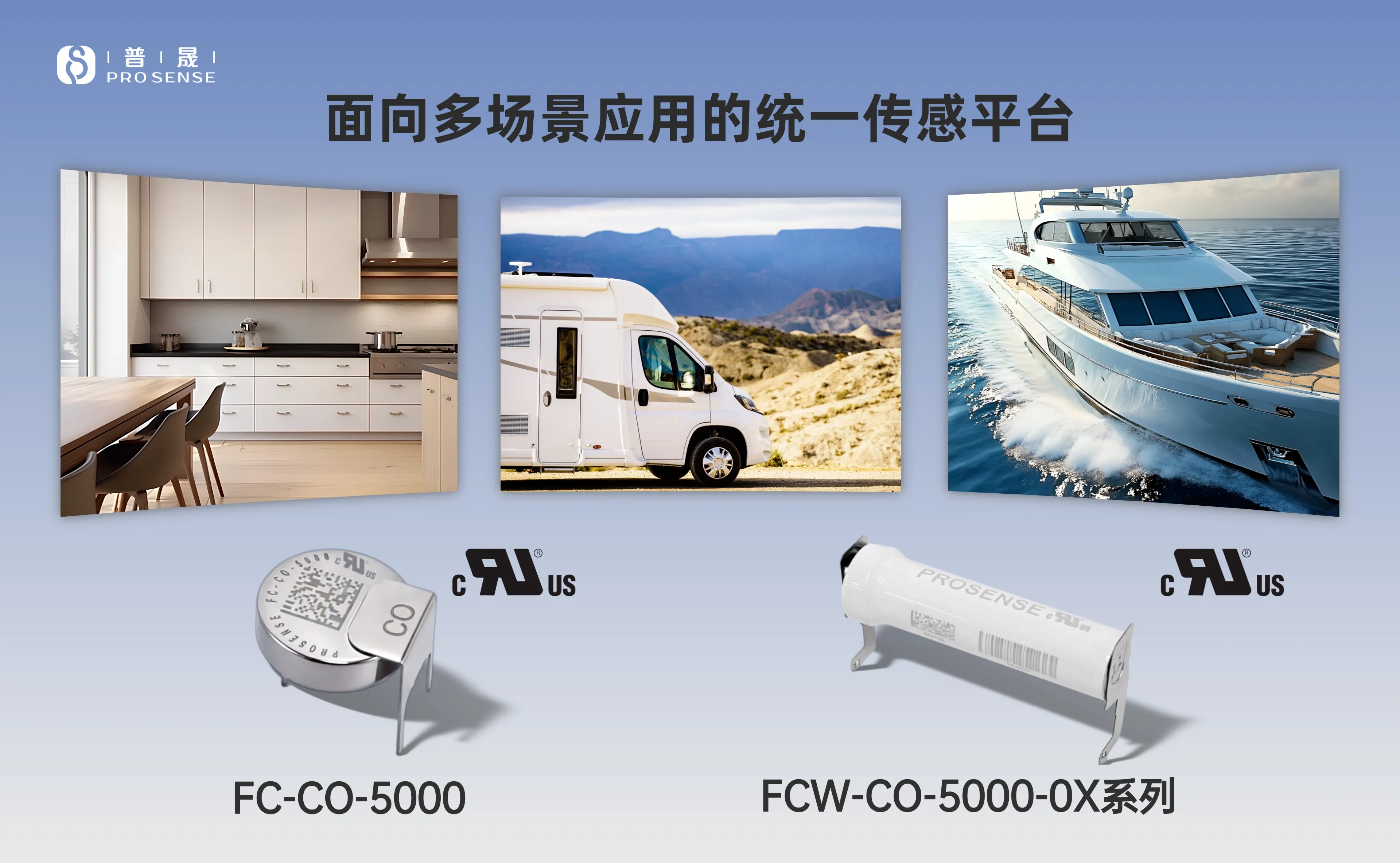
The FC-CO-5000 and FCW-CO-5000-0X series sensors are used, and the entire product can support meeting the following main standard requirements:
CSA 6.19-17
(Canadian Carbon Monoxide (CO) Alarm Standard)
UL 2034 (5th edition)
(Standard for Carbon Monoxide (CO) Alarm Devices for Residential Use in North America)
EN 50291-1
(European Standard for Carbon Monoxide (CO) Alarm Devices for Residential Use)
EN 50291-2
(European Standard for Carbon Monoxide (CO) Alarm Devices for Motorhomes and Ships)
This unified platform solution helps reduce design adjustments and duplicate certification work caused by differences in application scenarios, thereby improving development efficiency and optimizing the overall compliance path, making global compliance simpler and enabling alarm enterprise owners to operate worry free.
About ProSense
ProSense is a high-tech enterprise dedicated to the research and manufacturing of advanced gas sensors, committed to providing high-performance and high reliability sensing solutions for global customers. The company continues to invest in core technology research and development, overcome key pain points in the industry, and continuously lead the development direction of gas sensing technology. With innovative products and excellent quality, Pusheng Sensing is gradually growing into an important promoter and leader in the global gas safety monitoring field.
ProSense adheres to the full stack self-developed technology route, and has established a kilogram level gas sensor catalyst research and development base and an automated production aging calibration system for millions of gas sensors per year. Its product line covers the fields of toxic and harmful, flammable and explosive, and environmental gas detection; ProSense multiple innovative products have become core sensing components in vertical fields such as smart firefighting, industrial testing, and energy storage safety.