As the global energy storage market expands rapidly, China-manufactured battery cells, energy storage cabinets and containerized battery energy storage systems (BESS) are being deployed at an accelerating pace across Australia, the Middle East, Europe, North America, South Asia, Latin America and Africa.
China is the energy storage system manufacturing centers in the world. In the first half of 2026, Chinese energy storage companies secured approximately 298 GWh of new overseas orders. Of this total, the Middle East and Africa accounted for approximately 40 GWh, Australia for approximately 30 GWh and Europe for approximately 120 GWh. As cross-border deliveries continue to grow, a technical issue that has historically received limited attention is becoming increasingly important:
Before an energy storage system is placed into service, could exposure to high temperatures, enclosed conditions and contaminants during ocean transit and port storage already have affected the performance of the gas sensors inside the enclosure?
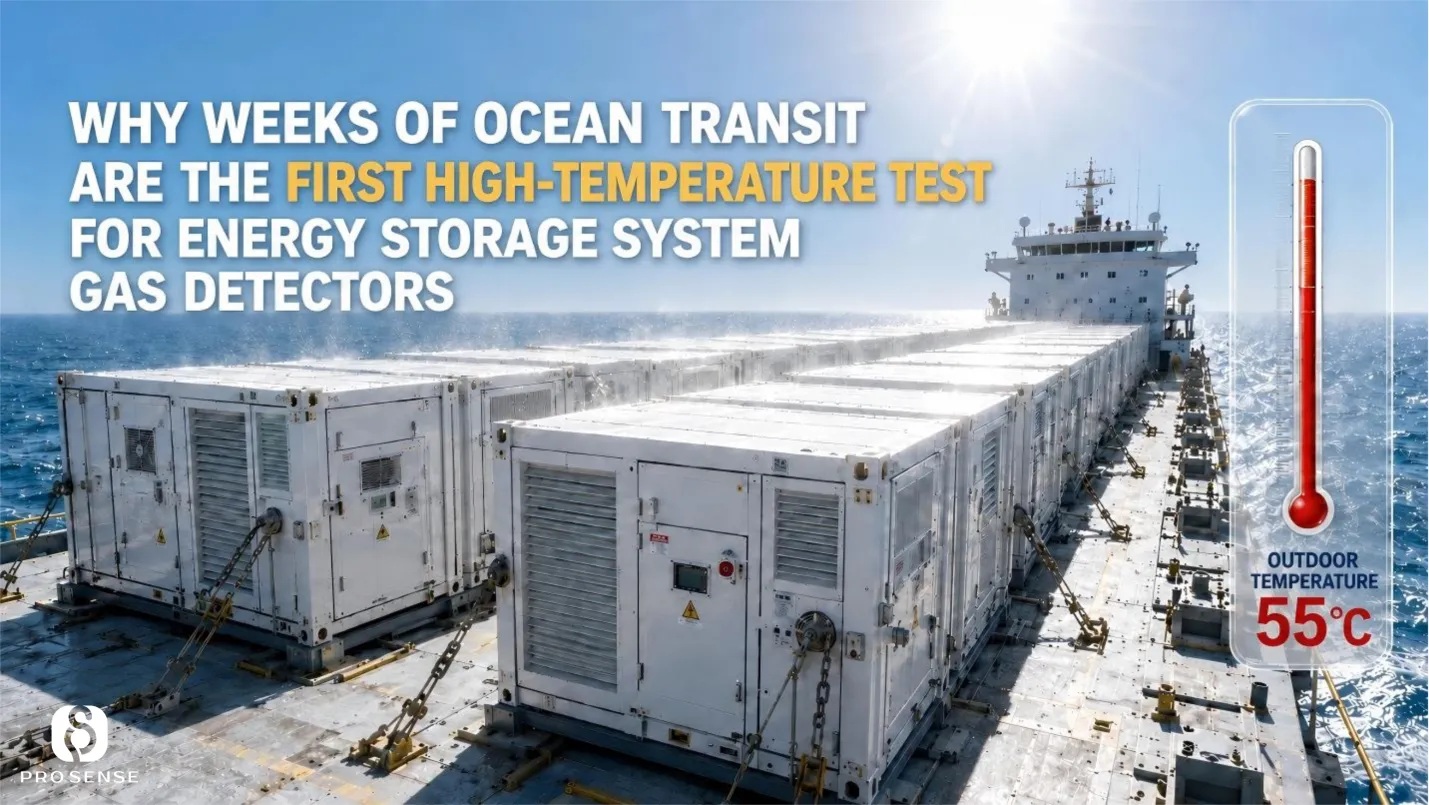
For gas sensors that support early thermal runaway warning, ventilation control and explosion risk mitigation, the transportation environment is not merely a logistics condition unrelated to product performance. It is part of the system’s lifecycle reliability.
Weeks of Ocean Transit: The First High-Temperature Test Before Commissioning
Transit Times from China to Key Destination Markets

* The actual supply chain cycle includes dangerous goods declaration at the Chinese port, waiting for vessel loading, ocean transit, transshipment, dangerous goods inspection at the destination port and container pickup. It excludes long-distance inland transportation in the destination country.
This means that, during transportation, an energy storage cabinet is not exposed to one stable temperature. It experiences a dynamic environment over an extended period, with potentially significant temperature variations.
Ambient Marine Temperature Is Not the Same as the Temperature Inside the Cabinet
Energy storage cabinets are typically placed in transport mode during shipment. Air-conditioning, liquid-cooling and active ventilation systems may be shut down, while the enclosure remains relatively sealed.
Container climate data published by the German Transport Information Service indicate that when the outside air temperature is approximately 25°C, the internal air temperature of a dark-colored steel container can rise to approximately 50°C. Even with a white exterior, the internal air temperature may reach approximately 38°C.
Research compiled by the National Research Council Canada on lithium-ion battery transportation environments further indicates that:
* When a container crosses the equator, its internal temperature may exceed 60°C during the day;
* A maximum internal container temperature of 57°C has been recorded on a route from Japan to the United States;
* Under direct solar exposure, the upper area of a container may be more than 15°C hotter than the outside air;
* Within the same container, the temperature difference between cargo at the top and bottom may approach 20°C.
Temperature Exposure During Ocean Transit

Why the Temperature Inside the Cabinet Can Be Significantly Higher Than the Ambient Marine Temperature
Short-wave solar radiation is absorbed by the metal enclosure and converted into heat. Because the HVAC system is typically shut down during transportation, airflow and heat dissipation inside the cabinet are limited. This creates a temperature gradient from the air surrounding the vessel to the cabinet surface, the air inside the cabinet and the battery modules. Because battery modules have substantial thermal inertia, they may heat more slowly than the internal air, but they may also release heat more slowly after ambient temperatures fall.

High Temperatures Accelerate Siloxane Emissions
Energy storage cabinets typically contain a range of sealing, insulating, thermally conductive and flame-retardant materials, which may include:
* Silicone rubber seals;
* Silicone sealants and potting compounds;
* Thermally conductive silicone, thermal pads and interface materials;
* Silicon-containing materials in cables, connectors and electronic components;
* Foams, coatings and other polymeric materials;
* Lubricants, cleaning agents and processing aids used during assembly and maintenance.
Some silicon-containing materials may contain residual low-molecular-weight cyclic or linear siloxanes, including D4, D5, D6 and other volatile methyl siloxanes. These substances may be released slowly even at room temperature. As temperature increases, the vapor pressure of volatile constituents generally rises, accelerating their diffusion through the material and migration into the surrounding air.
Published research indicates that volatile organic compound emission rates generally increase with temperature. Studies of silicone materials have likewise found that heating promotes the volatilization of cyclic siloxanes into the surrounding air.
Enclosed Conditions Can Amplify Accumulation
During ocean transit, energy storage cabinets are generally kept relatively sealed to protect against water and salt spray and to meet dangerous goods transportation requirements. Air-conditioning and ventilation systems may not operate continuously.
Under these conditions, siloxanes and other volatile substances inside the cabinet have limited pathways for dilution or removal. Even when the emission rate of a material is low, contaminants may accumulate in localized spaces over several weeks of transportation and port storage.
Even when a gas sensor is de-energized, its sensing material, catalytic interface, electrolyte, gas-permeable membrane and diffusion path may remain exposed to the air inside the cabinet. A loss of power does not isolate the sensor from the environment or eliminate the potential for contaminant exposure to affect subsequent performance.
After the cabinet arrives at the project site and is ventilated, the siloxane concentration inside the enclosure may decrease quickly. However, the effect on the gas sensor may already have occurred. This is one reason transportation-related risk can be overlooked: personnel may not detect an elevated contaminant concentration when the cabinet is opened, even though the sensor may already have experienced irreversible sensitivity loss.
Siloxane Poisoning Can Create a Hidden Gas Sensor Failure
Siloxanes do not affect all gas-sensing technologies in the same way. For sensors that depend on catalytically active materials or reactions at a sensing surface, volatile siloxanes may decompose at the sensing interface and form silicon-containing deposits or silica-like layers.
These deposits may:
* Cover or block catalytically active sites;
* Reduce contact efficiency between the target gas and the sensing material;
* Alter gas diffusion and surface reaction processes;
* Reduce sensitivity or increase response time;
* Affect zero stability, linearity or repeatability;
* Ultimately cause irreversible performance degradation.
Research has demonstrated that siloxanes can affect the response of catalytic combustion and metal oxide semiconductor sensors to hydrogen, carbon monoxide and other gases.
The most significant concern with siloxane poisoning is that it may not cause a loss of communication or an obvious electrical fault. The sensor may continue to provide an output, and the controller may continue to indicate “normal,” even though actual sensitivity has declined.
This hidden failure mode—an output remains available, but accurate detection is no longer assured—can be more difficult for the system to identify than a complete open-circuit failure.
High Temperature and Siloxane Exposure Are Not Independent Risks
In conventional sensor evaluations, high-temperature reliability and resistance to siloxane poisoning are often assessed separately:
* High-temperature testing confirms whether the sensor can operate at a specified temperature;
* Siloxane testing confirms whether the sensor continues to respond after contaminant exposure.
However, the ocean transportation environment for energy storage cabinets shows that these risks may occur simultaneously and amplify one another.
High temperatures can accelerate the release of volatile siloxanes from silicon-containing materials. Enclosed conditions can promote contaminant accumulation, while longer shipping routes increase the duration of sensor exposure. After arrival at the project site, the sensor must continue to perform under elevated operating temperatures, ongoing material emissions and long-term environmental contamination.
Accordingly, an evaluation appropriate for energy storage applications should go beyond asking:
Can the sensor withstand high temperatures?
Can the sensor withstand siloxane exposure?
It should also verify:
Following extended combined exposure to high temperature and siloxanes, can the gas sensor still detect the target gas accurately, consistently and reliably?
Required Capabilities for Gas Sensors Used in Energy Storage Systems
When selecting gas sensors for ocean transportation, storage and long-term operation, energy storage system manufacturers should give particular consideration to the following requirements.
1. Wide-Temperature Capability Covering Transportation and Operation
The sensor temperature range should cover not only normal operating conditions at the project site, but also unpowered transportation, port storage, system commissioning and abnormal high-temperature conditions.
For energy storage systems intended for global markets, validation of sensor transportation, storage and operating temperatures should extend from −40°C to +85°C, as appropriate for the destination market and actual shipping route. Sensitivity, zero stability, response time and repeatability should also be confirmed to remain within specified limits following high-temperature exposure.
A “maximum operating temperature” stated on a gas sensor data sheet is not equivalent to demonstrated long-term reliability at high temperature. Selection should also consider the test duration at the maximum temperature, applicable performance acceptance criteria and recovery after high-temperature exposure.
2. Quantitatively Validated Resistance to Siloxane Poisoning
“Poisoning resistance” should not be treated as a qualitative claim. It should be supported by repeatable, traceable test conditions and data, including:
* Siloxane type;
* Exposure concentration;
* Exposure duration;
* Temperature and humidity;
* Energized or de-energized condition;
* Sensitivity retention after exposure;
* Changes in response time and zero output;
* Evidence of any irreversible degradation.
3. Reliability Under Combined High-Temperature and Siloxane Exposure
Energy storage system manufacturers and gas sensor suppliers should establish combined test programs that more closely represent actual use conditions. High temperature, siloxanes, damp heat and extended exposure should be evaluated within an integrated validation framework. Full-cabinet or simulated-enclosure testing using the actual sealants, thermal materials, cables and flame-retardant materials installed in the energy storage cabinet can help identify potential compatibility risks between material emissions and gas sensors.
Certification Is the Foundation; Reliability in the Intended Application Is the Objective
For gas sensors, compliance with baseline certification requirements is only the starting point for integration into an energy storage safety system. More importantly, the product must maintain its detection capability over time under actual energy storage conditions, including:
* Does it remain accurate after high-temperature ocean transit?
* Does it retain sensitivity after siloxane exposure?
* Does it remain reliable under combined high-temperature and contaminant exposure?
* Does it recover properly after unpowered transportation?
* Does it maintain a stable output during long-term operation?
* Can the system identify performance degradation in a timely manner?
Two Critical Capabilities: Resistance to Siloxane Poisoning and Reliability at 85°C
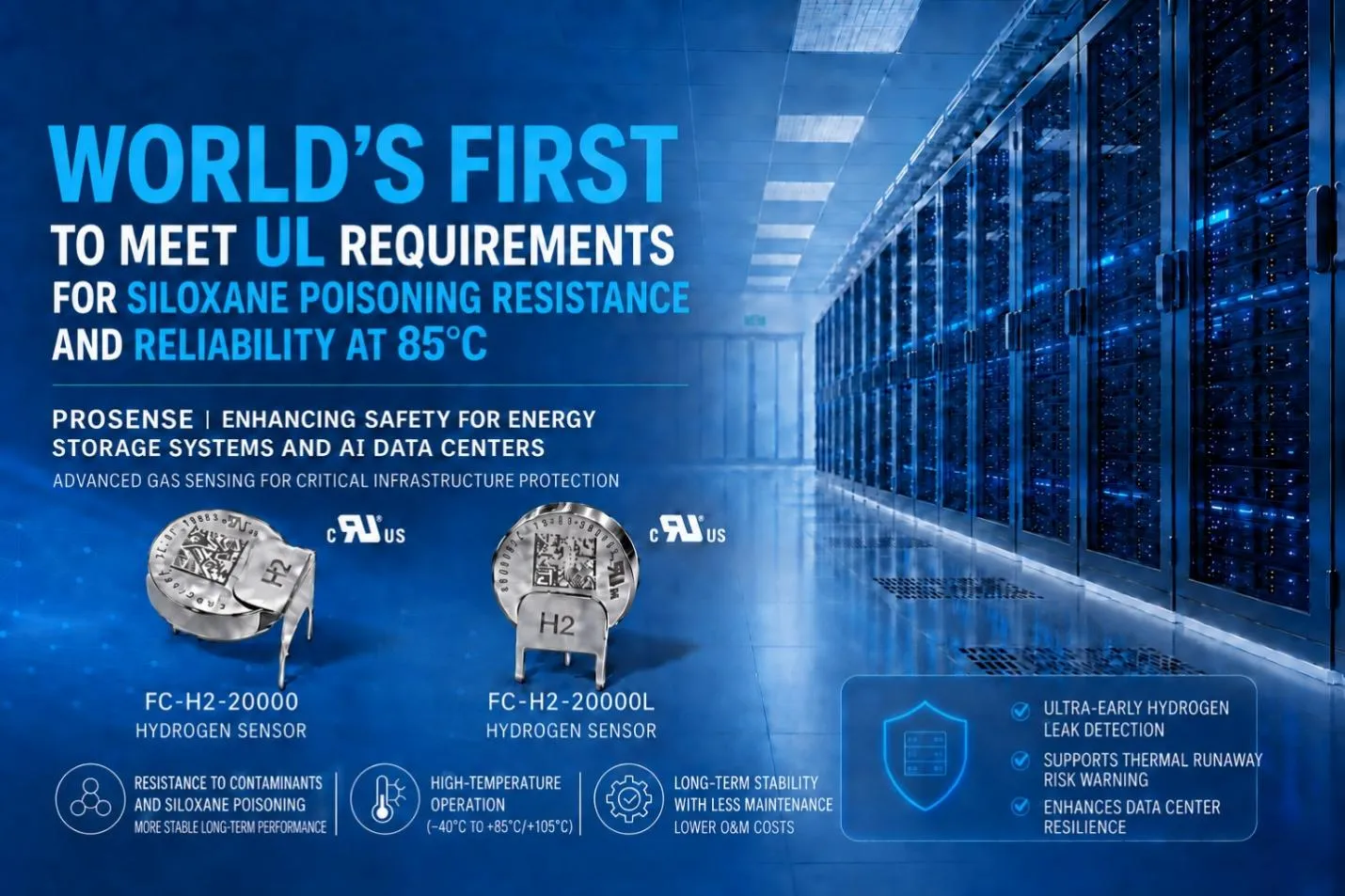
ProSense hydrogen and carbon monoxide fuel cell sensors, developed specifically for energy storage system applications, have an operating temperature range of −40°C to +85°C. ProSense is the world’s first advanced gas sensor brand to achieve relevant UL Solutions certification addressing both 1,024 hours of siloxane-poisoning resistance and reliability at 85°C. The validation assesses not only whether the sensor can detect the target gas under laboratory conditions, but also its ability to maintain detection performance over time in high-temperature and contaminant-exposed environments.
Reliability Under Siloxane Exposure
Evaluates the sensor’s ability to maintain stable detection performance and long-term reliability when exposed to siloxanes and other contaminants that may be present in actual applications.
Reliability at 85°C
Evaluates performance stability and environmental suitability at elevated temperatures for energy storage systems, AI data centers and other demanding, high-temperature applications.
From resistance to siloxane poisoning to reliability at 85°C, these capabilities represent more than an improvement in individual product performance. They reflect an important evolution in gas sensor evaluation—from initial accuracy under laboratory conditions to long-term reliability in the intended application environment.
(加入PROSENSE LOGO)
Gas Detection That Performs Throughout the Journey from Factory Release to Commissioning
The safety lifecycle of an energy storage system does not begin only when the project is connected to the grid or the equipment is energized. It begins when manufacturing is completed and the product enters storage and transportation.
Weeks of ocean transit, equator-crossing routes, direct solar exposure at ports, high internal cabinet temperatures and siloxane emissions in enclosed conditions can subject gas sensors to sustained, combined environmental stress before the equipment reaches the project site.
Gas sensor selection for energy storage applications should therefore move beyond comparison of individual specifications toward lifecycle reliability evaluation. Wide-temperature performance, resistance to siloxane poisoning, tolerance to combined environmental exposure, long-term stability and verifiability after transportation should be treated as key technical requirements.
About ProSense
ProSense is a high-technology company specializing in the research, development and manufacture of advanced gas sensors. The company is committed to providing high-performance, high-reliability sensing solutions to customers worldwide. Through sustained investment in core technologies, ProSense addresses critical industry challenges and advances the development of gas-sensing technology. With innovative products and a strong commitment to quality, ProSense is becoming an important contributor to and leader in global gas safety monitoring.
ProSense follows a vertically integrated, independently developed technology strategy. Its capabilities include a kilogram-scale catalyst development facility and automated production, aging and calibration systems with an annual capacity of tens of millions of gas sensors. The product portfolio covers toxic and hazardous gases, combustible and explosive gases, and environmental gas monitoring. Multiple ProSense innovations have become core sensing components in vertical markets including smart fire safety, industrial detection and energy storage safety.