As international standards continue to evolve, the industry is accelerating toward a new era of high-reliability, low-maintenance-cost industrial and commercial gas detection.
In recent years, the global energy transition, industrial digitalization, and the rapid development of emerging sectors such as new energy storage, petrochemicals, semiconductors, and data centers have presented unprecedented challenges to gas safety management at industrial sites. At the same time, investigations into major international industrial accidents have consistently demonstrated that gas leakage itself is not the sole cause of incidents—what truly determines the consequences is whether the gas can be detected in a timely, accurate, and sustained manner.
Consequently, industrial gas detectors are evolving from conventional alarm devices into integral components of industrial safety management systems. Their long-term reliability, lifecycle performance, and total cost of ownership (TCO) have become key focal points for end users, equipment manufacturers, and standards organizations worldwide.
The Importance of Industrial Gas Detection as Seen Through Accident Investigations
In recent years, multiple accident investigation reports issued by the U.S. National Transportation Safety Board (NTSB), the U.S. Chemical Safety Board (CSB), and Canadian occupational health and safety regulatory agencies (CNESST) have indicated that failure to detect flammable gas leaks in a timely manner, ineffective interlocking of alarm systems, inadequate equipment maintenance, and insufficient personnel emergency response capability for hazardous gases are significant contributing factors to the escalation of explosions and fire incidents.
These incidents span multiple industries, including food processing, chemical manufacturing, oil and gas storage and transportation, and welding operations. While the investigation findings vary, they all reflect a common reality: a reliable gas detection system is a critical line of defense in preventing major industrial accidents.
Modern industrial safety philosophy has progressively shifted from reactive post-incident response toward risk prevention and continuous monitoring—and high-reliability gas detection systems are precisely the key technological enabler for achieving intrinsic safety.
International Standards Continuously Evolve, Driving the Industry Toward Higher Reliability
To ensure that industrial gas detectors continue to function effectively under real-world operating conditions, international standards are continuously refining product performance evaluation frameworks.
Currently, the major international standards include:
- IEC 60079-29-1 – International performance standard for flammable gas detectors for use in explosive atmospheres
- EN 60079-29-1 – European harmonized standard, serving as an important technical basis for ATEX, UKCA, and other regulatory frameworks
- UL 60079-29-1 – North American product performance standard, adding requirements for dustproof/waterproof performance claim verification, fault verification, and software evaluation on top of the IEC foundation
- CSA 60079-29-1 – Canadian certification basis for industrial gas detector performance
These standards not only specify performance requirements for measurement accuracy, response time, environmental adaptability, long-term stability, and mechanical reliability, but also reflect the industry's heightened expectations for long-term reliable operation.
The focus of these standards has progressively shifted from "whether the product can detect" to "whether the product can maintain reliable detection capability throughout its entire lifecycle."
Industry Trend: The Traditional "Periodic Calibration" Model Is Facing New Challenges
For decades, industrial fixed gas detectors have primarily relied on periodic calibration to maintain detection accuracy.
Based on manufacturer recommendations, site-specific risk assessments, and applicable regulatory requirements, different sensor types typically require on-site calibration every 3 to 6 months—or even more frequently—to ensure that equipment continues to meet performance requirements.
This model has effectively supported industrial safety development over the past decades. However, as the scale of industrial installations continues to grow and demands for continuous production increase, its limitations are becoming increasingly apparent.
First, maintenance costs are continuously rising.
In large petrochemical plants, natural gas stations, battery energy storage systems (BESS), data centers, and semiconductor fabrication facilities, the number of fixed gas detectors often reaches hundreds or even thousands.
Each on-site calibration requires not only skilled technicians but also involves calibration gases, calibration equipment, shutdown coordination, work permits, elevated work access, and maintenance record management. As the number of devices continues to grow, maintenance workload and operational costs steadily increase. An increasing number of enterprises are beginning to focus on the total cost of ownership (TCO) of equipment, rather than merely the procurement cost.
Second, the maintenance process itself introduces safety risks.
Many detectors are installed in hazardous areas, elevated platforms, confined spaces, or near continuously operating units. Every manual maintenance intervention means personnel entering risk zones. For oil and gas facilities, offshore platforms, large-scale energy storage power stations, and chemical plants, reducing unnecessary on-site maintenance is itself an important measure for enhancing intrinsic safety.
More notably, periodic calibration does not equal sustained reliability.
Between two calibration intervals, sensor performance may change due to environmental contamination, silicon poisoning, chemical poisoning, long-term aging, or other interfering factors. If relying solely on fixed-interval calibration, there is no guarantee that equipment will maintain optimal detection performance throughout the entire operating cycle.
Consequently, the industry's focus is gradually shifting from "whether calibration is completed on schedule" to "how to continuously ensure reliable detector operation throughout the entire lifecycle."
Long-Term Maintenance-Free Operation Is Becoming an Important Direction for International Industry Development
In recent years, leading international end users, equipment manufacturers, and industry stakeholders have been actively promoting the evolution of industrial gas detection technology toward long-term maintenance-free operation.
This trend is not simply about reducing calibration frequency; rather, it is about reducing maintenance requirements while maintaining safety—by enhancing intrinsic sensor reliability and system intelligence—thereby achieving a dual improvement in safety and economy.
Key drivers of this trend include:
Higher safety requirements. For life-safety equipment, what truly needs to be guaranteed is sustained reliable operation throughout the entire service life, not merely meeting performance requirements for a short period immediately after calibration.
Lower operational costs. Reducing on-site calibration and maintenance significantly lowers labor costs, calibration gas consumption, shutdown coordination expenses, and high-risk operation costs, optimizing overall lifecycle operational costs.
Smarter equipment management. Technologies such as online self-diagnostics, condition monitoring, predictive maintenance, and remote health management are maturing, driving equipment management models to progressively transition from time-based maintenance to condition-based maintenance.
At the same time, Prosense and leading industrial gas detector brands are achieving continuous breakthroughs in next-generation sensing technologies in terms of long-term stability, anti-silicon-poisoning, anti-chemical-poisoning, low drift, and environmental adaptability, providing the technical foundation for extended maintenance intervals and even maintenance-free operation.
It must be emphasized that long-term maintenance-free does not mean completely maintenance-free. For industrial safety equipment, necessary functional testing, system inspections, and preventive maintenance should still be performed in accordance with manufacturer's instructions and risk assessment requirements to ensure that equipment remains in effective operating condition.
The Direction of International Standards Is Highly Aligned with Industry Technology Trends
It is noteworthy that the development direction of international standards is strongly aligned with industry technology trends.
In recent years, whether in IEC 60079-29-1, UL 60079-29-1, or relevant product certification requirements, increasing attention has been placed on:
- Long-term Stability
- Environmental Robustness
- Immunity to Interference and Poisoning
- Fault Detection Capability
- Software and Functional Safety
- Lifecycle Performance Consistency
The focus of standard evaluation has extended beyond initial performance under laboratory conditions to place greater emphasis on long-term reliable performance in real-world industrial environments.
The Core of Future Competition: From "Standards Compliance" to "Long-Term Reliability"
Future competition in the industrial gas detection industry will no longer be confined to detection accuracy, but will revolve around long-term reliability, total cost of ownership, and lifecycle safety management.
Leading international manufacturers are actively advancing higher-reliability sensing technologies, smarter equipment diagnostic capabilities, and product solutions with extended maintenance intervals, continuously reducing on-site maintenance requirements and operational costs while providing more stable and reliable safety protection for critical infrastructure.
Looking ahead, technical solutions that can significantly reduce maintenance costs while ensuring safety, minimize on-site operational risks, and consistently maintain detection performance uniformity will become a key development direction for the industrial gas detection industry—and will further propel global industrial safety management to higher levels.
Prosense Gas Sensing Solutions Specifically for Industrial Applications
As a leading provider of advanced gas sensor R&D and manufacturing, Prosense starts from the real-world complexities of the field and continues to drive technological breakthroughs and international compliance progress in industrial application scenarios.
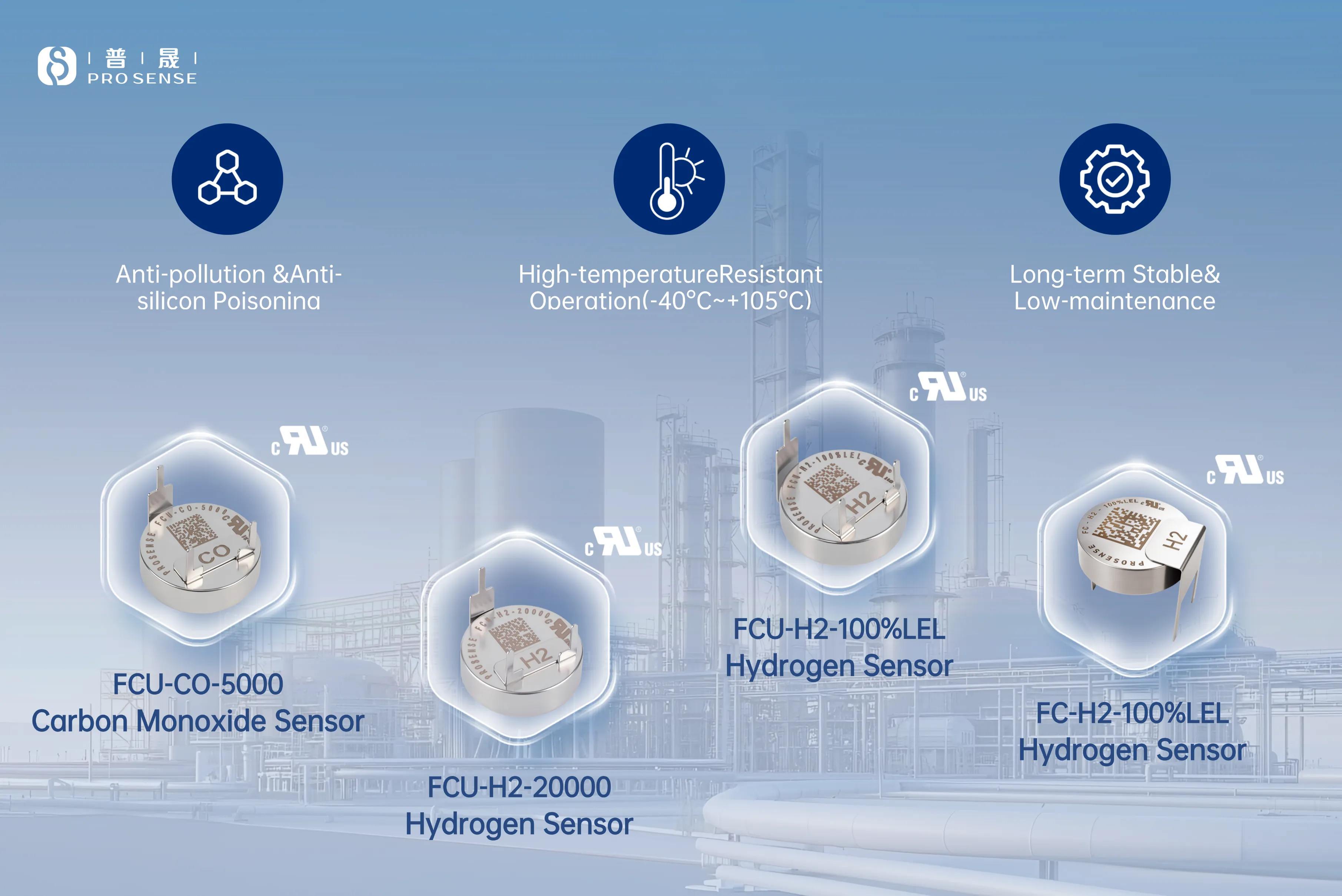
The company's new carbon monoxide and hydrogen sensor series specifically designed for industrial vertical applications have recently obtained UL 2075 certification for the US and CAN/ULC 588 certification for Canada, with an operating temperature range covering -40°C to 105°C. They have become industry benchmarks in environmental adaptability, long-term stability, anti-silicon poisoning, reliability, and maintenance-free operation, providing enhanced safety protection for critical industrial facilities worldwide.
Advanced gas sensing solutions for industrial vertical applications include:
- Anti-contamination and anti-silicon poisoning design: Effectively reduces chemical coating of sensing elements by interferents such as VOCs and siloxanes, enhancing hydrogen and carbon monoxide sensor stability in long-term high-contamination environments.
- High-temperature performance optimization: Meets the continuous detection requirements of industrial environments under high-temperature operating conditions.
- Lifecycle stability enhancement: Extends effective sensor operating life, reducing on-site replacement frequency, maintenance needs, and drift risks.
Closing Remarks
Industrial safety is never a one-time investment—it is a continuous management process that spans the entire lifecycle of equipment.
The continuous upgrading of international standards not only establishes a unified technical benchmark for the industry but also drives gas detection technology from "meeting performance requirements" toward "long-term reliable operation."
About Prosense
Prosense is a high-tech enterprise specializing in the R&D and manufacturing of advanced gas sensors, committed to providing global customers with high-performance, high-reliability sensing solutions. The company continues to invest in core technology R&D, tackling critical industry challenges and steadily leading the development direction of gas sensing technologies. With innovative products and exceptional quality, Prosense is progressively emerging as a significant driver and leader in the global gas safety monitoring sector.
Prosense adheres to a full-stack in-house R&D approach, having established a kilogram-level catalyst development base for gas sensors and an automated production and aging/calibration system with an annual output of tens of millions of gas sensors. Its product portfolio covers toxic, hazardous, combustible, explosive, and environmental gas detection applications. Multiple innovative products from Prosense have become core sensing components in vertical markets such as smart fire protection, industrial safety, and energy storage safety.