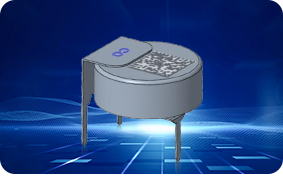
In recent years, with the continuous improvement of global residential life safety regulations, carbon monoxide (CO) alarms have become an important safety configuration for European and American households. From UL 2034 in the United States to EN 50291-1 and EN50291-2 in Europe, the technical requirements for vertical applications continue to increase, driving the industry to continuously improve product safety levels.
At the same time, the multiple typical product recall cases publicly released by European and American regulatory agencies in recent years have also sent a clear signal to the industry:
The carbon monoxide alarm industry is moving from "certified" to "long-term reliable".
For carbon monoxide alarm manufacturers, what truly determines the value of their products is not only their ability to pass third-party testing and certification, but also their ability to reliably and stably issue accurate alarms throughout their claimed lifespan of five, seven, or even ten years.
In this context, sensor solutions with mature engineering capabilities and a deep understanding of North American regulations and standard systems are becoming a key support for alarm manufacturers to achieve compliant market launch and long-term reliable operation.
Industry Insights from the Recall Cases of Carbon Monoxide Detectors in Europe and America
Some typical carbon monoxide alarm product recall cases publicly released by local regulatory agencies in the European and American markets mainly focus on the following aspects:
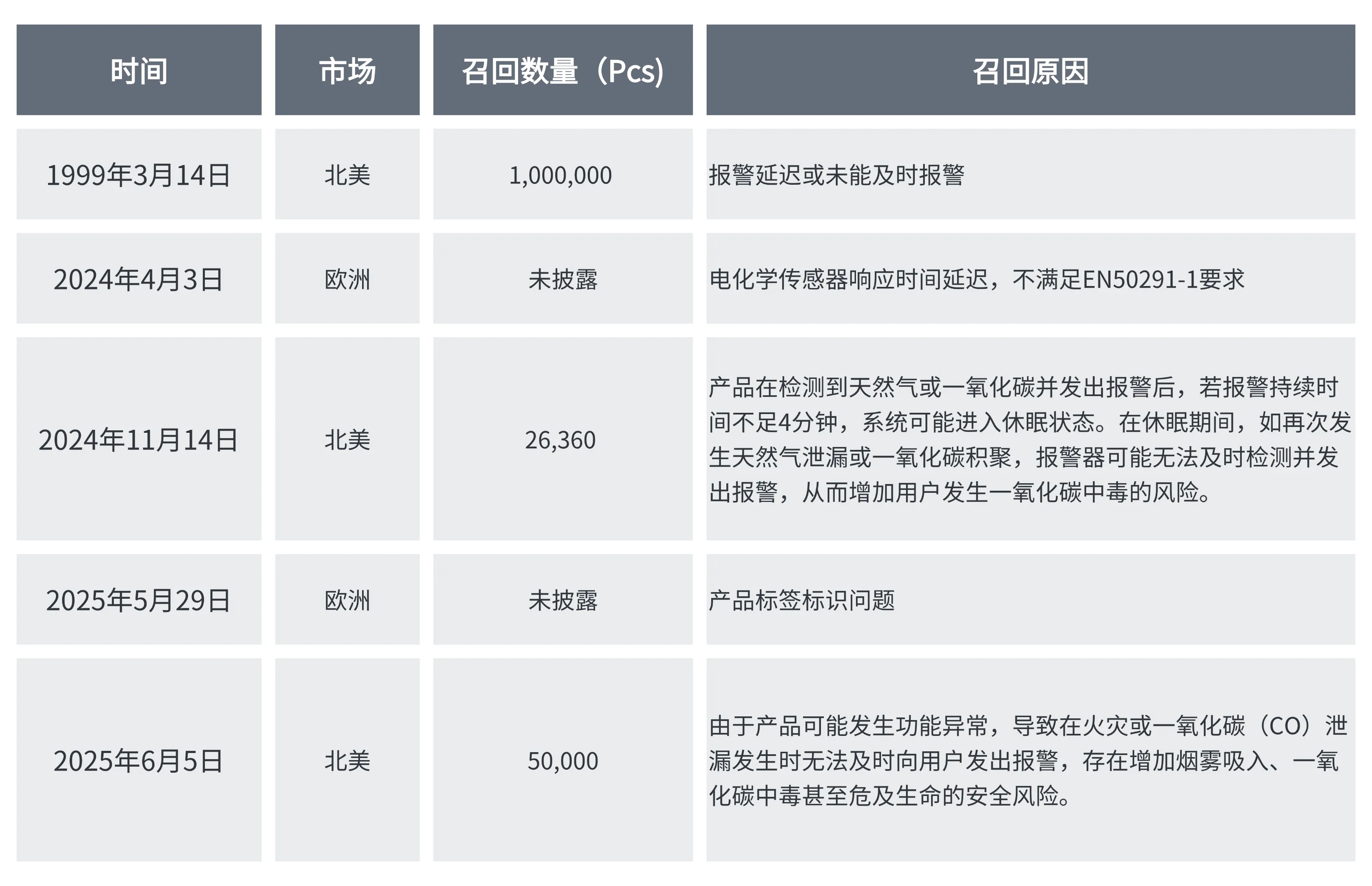
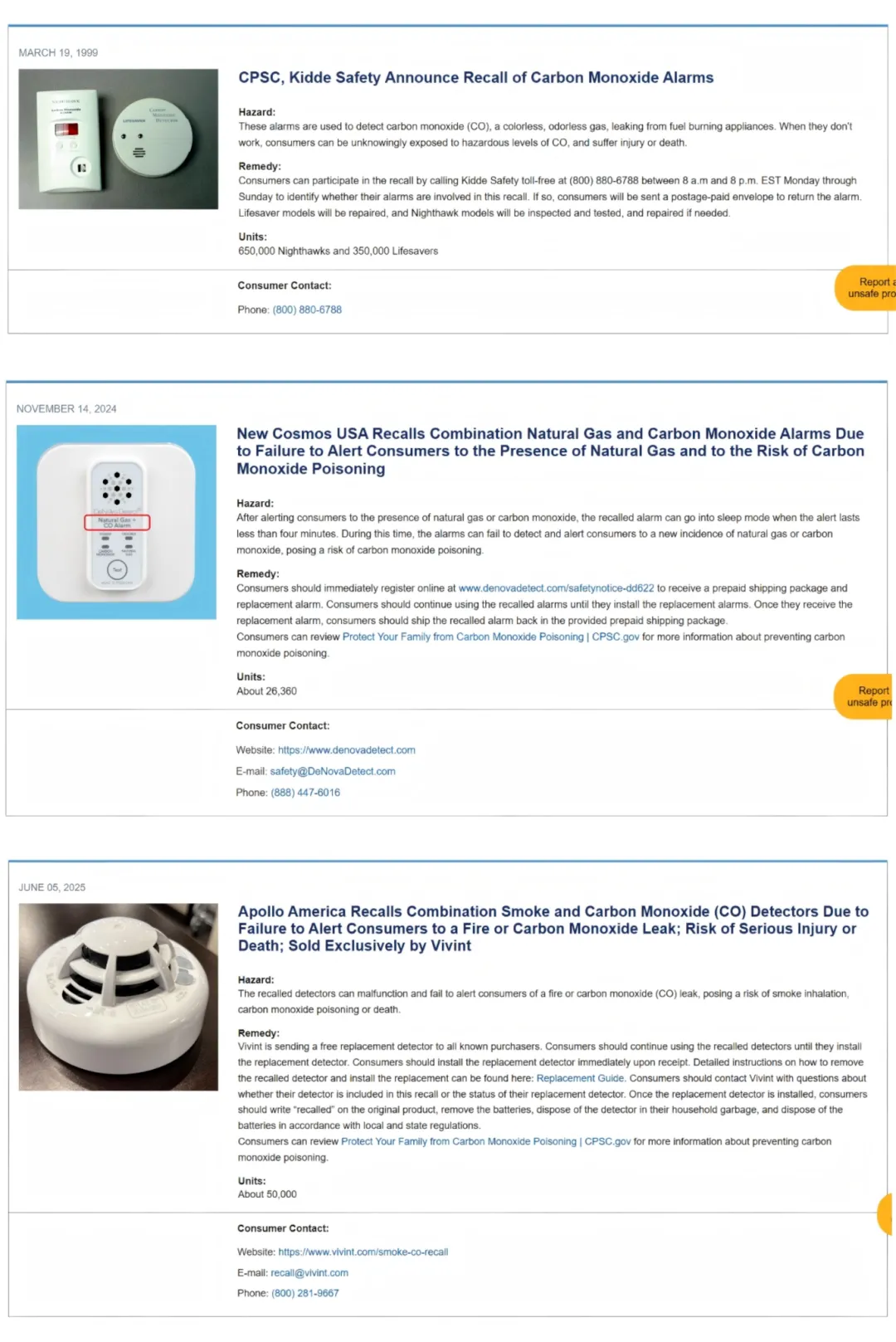
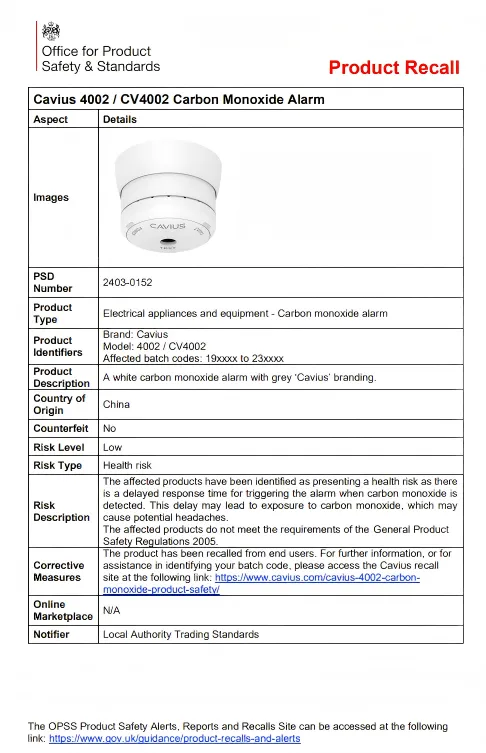
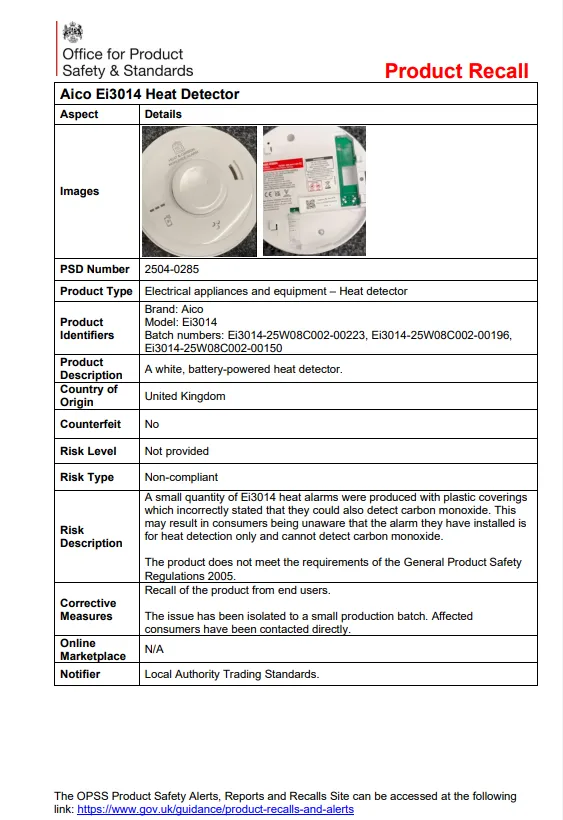
Swipe left and right to view more
CPSC Consumer Safety Commission - Issue Product Recall Inquiry Official Website
https://www.cpsc.gov/Recalls
EU Market - Issue Product Recall Inquiry Official Website
https://ec.europa.eu/safety-gate-alerts/
UK - Issue Product Recall Inquiry Official Website
https://www.gov.uk/product-safety-alerts-reports-recalls
From product recalls to the four major trends in industry development
1、 Response speed is a key indicator of life safety
For carbon monoxide detectors, the response time is directly related to the safety of consumers' lives.
In recent years, public cases have shown that even if a product can eventually trigger an alarm, if the response time exceeds the safety window specified by the standard, it still brings great security risks.
Therefore, response speed has become one of the core indicators for measuring product reliability.
2、 Long term reliability has become a new competitive advantage
In practical use, the working environment faced by the whole machine alarm and its internal sensors is often more severe and complex than laboratory testing conditions, posing higher challenges to core sensing technology. Throughout the entire lifecycle of the product, it needs to continuously face:
High and low temperature environments
High humidity and condensation
Kitchen oil fume
Cleaning agents and alcohol
Perfume and air freshener
Complex interferences such as volatile organic compounds (VOCs)
Any long-term drift, performance degradation, or change in response speed may affect the final alarm performance.
Therefore, more and more international brands are establishing long-term reliability verification systems that cover the entire product lifecycle, rather than just focusing on testing and certification.
3、 Water free and anti toxic capabilities have become important directions for the next generation of CO sensing technology
In recent years, the international industry has increasingly focused on the frequent failure of water system CO sensors, as well as the impact of pollutants such as siloxanes and volatile organic compounds (VOCs) on the long-term performance of gas sensors.
For electrochemical gas sensors, long-term exposure to complex environments may lead to decreased catalytic activity, changes in response speed, or sensitivity degradation.
Therefore, waterless design, anti silicon poisoning, and anti VOC interference design are gradually becoming important development directions for high reliability gas sensors, and are also important technical capabilities for future product differentiation competition.
4、 Functional safety has been extended to the entire system
In recent years, public cases have also shown that the reliability of an alarm depends not only on the sensor itself, but also on:
signal acquisition
software algorithm
power management
communication system
Whole machine functional safety design
High reliability alarms will place greater emphasis on the collaborative design between carbon monoxide sensors, electronic hardware, and software systems to achieve truly reliable operation of the entire system.
Three typical household application scenarios and differentiated compliance requirements
According to standard definitions and market applications, carbon monoxide detectors are mainly divided into the following three types of application scenarios:
1. Application of fixed installation type in residential buildings
Suitable for permanent installation on walls or ceilings in residential environments, with a focus on long-term stability, low false alarm rates, and adaptability to daily environments.
2. RV and non temperature controlled area applications
Suitable for RVs and environments without temperature control, requiring greater temperature and humidity changes, vibration, and intermittent use conditions.
3. Yacht applications
For water scenes such as entertainment boats, in addition to temperature and humidity fluctuations, salt spray environment, mechanical vibration, and more stringent power supply and installation conditions also need to be considered.
For the application scenarios of RVs and yachts, both UL 2034 and CSA 6.19 standards have introduced additional environmental adaptability and reliability testing requirements. In practical use, the working environment faced by the whole machine alarm and its internal sensors is often more severe and complex than laboratory testing conditions, posing higher challenges to core sensing technology.
Core challenge: Sensor environmental adaptability determines overall reliability
In multiple application scenarios, the performance of carbon monoxide detectors highly depends on the environmental adaptability of their core sensors, including:
Stable response capability under wide temperature range
Consistency and drift control in long-term operation
Reliable working ability under factors such as vibration and humidity changes
For complete machine manufacturers who hope to enter the residential, RV, and yacht North American markets simultaneously, choosing sensor solutions with multi scenario compliance capabilities and mature engineering verification foundations is an important prerequisite for reducing certification risks and accelerating the listing process.
ProSense FC-CO-5000 and FC-CO-5000-0X: A Unified Sensing Platform Covering Multiple Scenarios
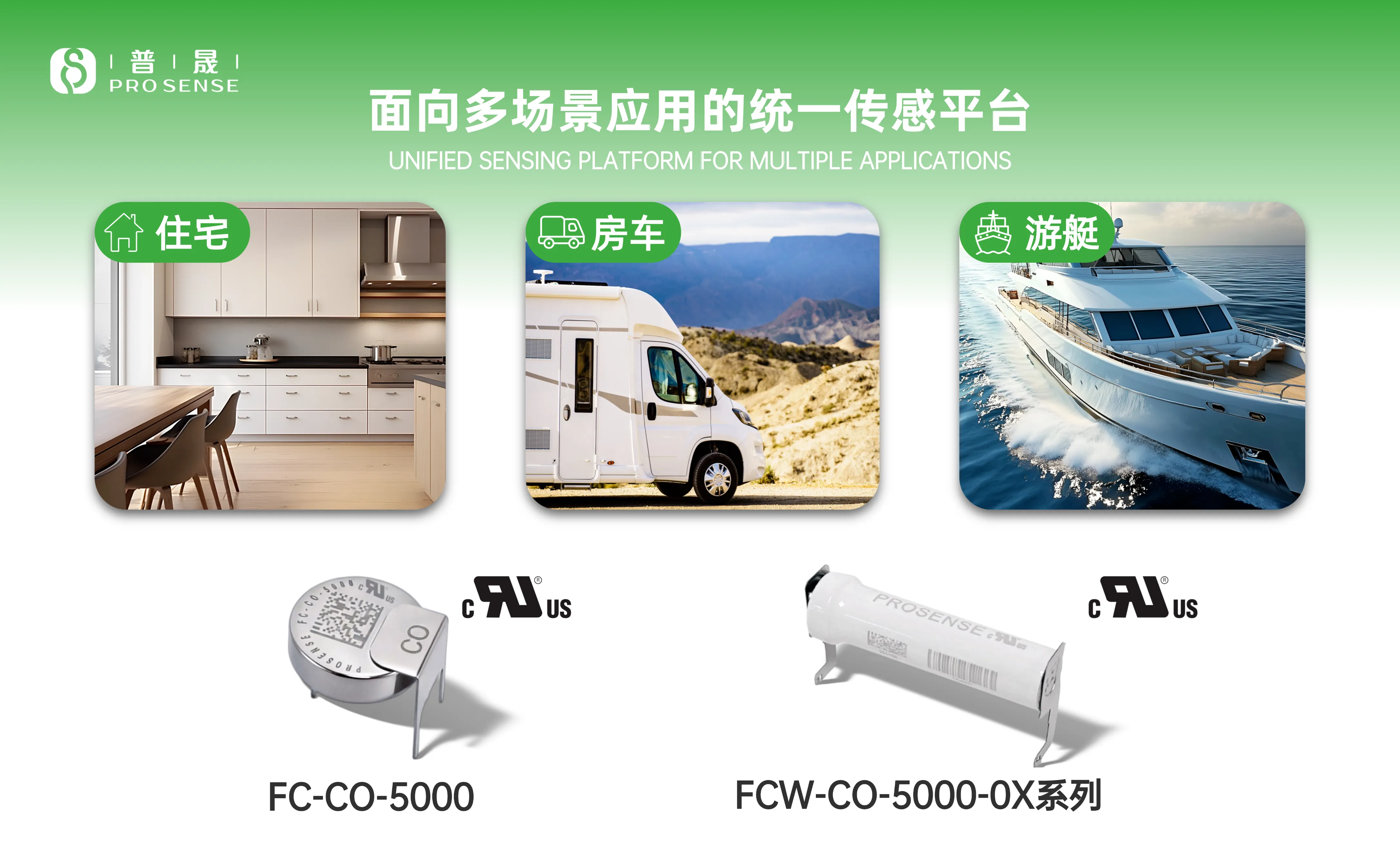
Focused on core material science, international standard participation, and vertical application landing, ProSense has launched the FC-CO-5000 and FCW-CO-5000-0X series of waterless all solid state fuel cell technology carbon monoxide sensors based on independent research and development capabilities. It is currently the only CO sensor solution in the industry that meets UL certification requirements for multiple application scenarios in residential, RV, and yacht areas in both the European Union and North America.
image
In the design phase, the product is systematically planned around multi application scenario compliance and long-term reliable operation, fully considering the comprehensive requirements of temperature adaptability, stability, and consistency of sensors under different environmental conditions. This helps the whole machine manufacturer build a product portfolio covering multiple markets on a single sensing platform.
By adopting FC-CO-5000 and FCW-CO-5000-0X, complete machine manufacturers can reduce the design and certification complexity caused by differences in application scenarios while meeting the requirements of EN50291-1, EN50291-2, UL 2034 (5th edition), and CSA 6.19-17 standards.
Market oriented value
Unified platform: One sensor covers multiple application scenarios, simplifying product portfolio
Compliance guarantee: supporting certification needs in the mainstream residential, RV, and yacht markets in North America
Reliable operation: Adapt to complex environmental conditions and enhance the long-term stability of end products
Accelerating time to market: reducing the time and cost pressure of repeated testing and re certification
From Technology to Standards: Compliance Capability Originates from Deep Participation in Standards
In addition to its engineering capabilities at the product level, Pusheng Sensing actively participates in the construction of the North American gas safety related standard system and is the only member of the technical committees authorized by UL 2075, UL 2034, and UL 2201 in the Asia region of ULSE. Through long-term participation in standard discussions and technical reviews, ProSense maintains a continuous and in-depth understanding of the safety logic, testing boundaries, and future evolution directions behind standard terms.
This role enables Pusheng Sensing to advance standard requirements to the product design and verification stage, and provide feedback on actual engineering experience to the standard system, helping customers form clear judgments on compliance paths in the early stages of product development, reducing repeated testing and uncertainty.
The core value created for alarm manufacturers
Expected compliance: Based on mature standard understanding and certification experience, reduce market access risks in North America
Platform based design: Series sensors cover multiple application scenarios, simplifying product line layout
Engineering reliability: To cope with complex environmental conditions and improve the long-term stability of end products
Efficiency improvement in listing: reducing the time and cost pressure caused by repeated testing and re certification
Conclusion
With the continuous evolution of residential and travel scenarios in Europe and America, carbon monoxide safety protection is extending to more diverse and complex application environments. ProSense provides a reliable and unified solution for carbon monoxide alarm manufacturers in the European and American markets through advanced gas detection technology, mature engineering verification system, and deep participation in international standards, helping customers achieve the dual goals of compliant listing and long-term stable operation under strict safety standards.
About ProSense
ProSense is a high-tech enterprise dedicated to the research and manufacturing of advanced gas sensors, committed to providing high-performance and high reliability sensing solutions for global customers. The company continues to invest in core technology research and development, overcome key pain points in the industry, and continuously lead the development direction of gas sensing technology. With innovative products and excellent quality, ProSense is gradually growing into an important promoter and leader in the global gas safety monitoring field.
ProSense adheres to the full stack self-developed technology route, and has established a kilogram level gas sensor catalyst research and development base and an automated production aging calibration system for millions of gas sensors per year. Its product line covers the fields of toxic and harmful, flammable and explosive, and environmental gas detection; ProSense multiple innovative products have become core sensing components in vertical fields such as smart firefighting, industrial testing, and energy storage safety.