Defining Reliability in Real-World Conditions, Enabling Next-Generation Critical Infrastructure Safety with Precise Sensing
Following its full English-language interview with the international fire and safety professional media 《International Fire & Safety Journal》 (IFSJ) in Birmingham, UK, this past April, Ms. Zhao Li, General Manager and Chief Engineer of Prosense, has once again engaged in a one-on-one in-depth interview with IFSJ Editor-in-Chief Lewis Tyler.
The conversation centered on the risks of contamination, poisoning, and potential failure of gas detectors and sensors in the complex environments of energy storage systems, quantitative hydrogen concentration measurement, and how low-concentration, multi-level hydrogen monitoring can build a more forward-looking risk early-warning framework. The discussion further explored the practical value of trustworthy gas detection data for energy storage system and AI data center owners, insurance institutions, AHJs (Authorities Having Jurisdiction), and system integrators.
From "whether it can detect"to "whether it can measure accurately";
from single-point alarming to continuous risk perception;
from compliance fulfillment to full-lifecycle risk management support—
Gas detection is evolving from traditional safety equipment into a critical sensing gateway for risk management in key infrastructure.
From the Lab to the Field: The Real Challenge Begins After Deployment
As global energy storage systems continue to scale up, and as AI data centers drive rapidly growing demand for high-density energy infrastructure, gas detection is becoming an integral component of early thermal runaway warning and risk management systems.
However, in real-world applications, completing equipment installation does not mean risk management is accomplished.
The real challenge often begins only after the equipment enters the field.
Inside energy storage enclosures, there are cells, sealing materials, thermal interface materials, adhesives, potting compounds, insulation materials, and other polymeric substances. As equipment operates over extended periods and materials age, these substances may continuously release various types of volatile compounds.
At the same time, high humidity, condensation, temperature cycling, complex background gases, and long-term unattended operation collectively create an application environment far more complex than standard laboratory conditions.
These factors may not only affect gas measurement accuracy. For certain sensing technology platforms, they may also cause contamination, cross-interference, sensitivity degradation, and even sensor poisoning and failure.
This brings up a question that has long been overlooked:
The detector is "online"—but does that mean the sensor still has reliable detection capability?
The detector may still be powered.
Communication may still be normal.
The system may still be outputting data.
But if the sensing element has already been contaminated or poisoned, its actual response capability to the target gas may have changed. Therefore, for gas detection systems that perform safety functions, monitoring only the equipment's online status is not sufficient to fully determine its true detection capability.
True reliability means that after real-world exposure and long-term operation, when a risk event occurs, the system can still sense accurately.
Sensor Poisoning: The Long-Term Reliability Challenge Facing Energy Storage Gas Detection
Sensor poisoning is not a new issue in industrial gas detection. However, as gas detection enters the new application environment of energy storage systems, its importance is being re-evaluated.
Inside energy storage cabinets, a wide range of sealing, thermal interface, potting, and other functional materials are used. Some of these materials may release siloxanes, VOCs, and other volatile substances over long-term operation.
For specific sensing technology platforms, these substances may adsorb onto, coat, or chemically interact with the sensing material surface, thereby altering sensor response characteristics.
What is more concerning is that such performance changes do not necessarily manifest as traditional "equipment failures."
Therefore, gas detector design for energy storage thermal runaway management needs to move beyond conventional initial performance evaluation toward:
Real-world application environmental adaptability, anti-contamination and anti-poisoning capability, long-term drift control, and full-lifecycle reliability.
For an energy infrastructure asset designed to operate for ten years or more, the question a safety sensor truly needs to answer is not just:
Can it detect today?
but rather:
Will it still detect reliably years from now?
From "Detecting Hydrogen" to "Measuring Hydrogen Accurately"
Another core topic in this IFSJ interview was quantitative hydrogen measurement.
In traditional gas alarm systems, gas detection is typically structured around preset alarm thresholds.
When a set concentration is reached, the system triggers an alarm.
This model can answer a basic question:
Has a certain risk threshold been reached?
But for energy storage systems and AI data centers, as safety management evolves further toward ultra-early identification and proactive risk management, the information provided by a single threshold is increasingly insufficient to cover the full risk evolution process.
If the system can continuously and accurately measure hydrogen concentration, it can further obtain:
When the abnormal gas began to appear;
The actual current concentration level;
Whether the concentration is rising or falling;
The rate of concentration change;
Whether the risk is still progressing.
This means that gas detection no longer provides just a discrete alarm signal, but rather a continuous dataset that reflects the risk evolution process.
From alarm signal to risk data—this is a significant extension of the value of gas detection.
Why Low-Level Hydrogen Monitoring Is Becoming Increasingly Important
For safety systems, time itself is a critical resource for risk management. The earlier an anomaly is detected, the more time the system has for assessment, verification, and response.
In the early stages of thermal runaway development in energy storage systems, if hydrogen changes can be stably identified at low concentration ranges and credible concentration data can be continuously obtained, it becomes possible to establish a more forward-looking risk observation window before traditional high-concentration alarm thresholds are reached.
This is the significance of low-level hydrogen monitoring.
It is not simply about pursuing "the lower the detection limit, the better."
The real technical value lies in:
Achieving stable, accurate, and repeatable quantitative measurement even at low concentration ranges.
Because only credible data can be further used for risk judgment.
From Single Alarm to Multi-Level Warning: Building a More Complete Hydrogen Risk Management Framework
Risk development is typically continuous, and safety responses should not have only two states: "normal" and "alarm."
Based on stable low-level quantitative hydrogen measurement capability, a multi-level monitoring and warning system can be further established, enabling different risk management strategies based on concentration levels, trends, and system status.
In the early anomaly stage, low-concentration gas changes can identify potential irregularities, providing a basis for inspection and further diagnosis. When concentration continues to rise, the risk level can be escalated, triggering operations and maintenance intervention or further safety responses. As the risk progresses further, system-level interlocking with ventilation, BMS, fire alarm, equipment control, and other safety systems can be enacted according to system safety design.
After reaching higher risk levels, corresponding emergency response strategies can be executed. Therefore, the core of a multi-level warning system is not simply adding more alarm thresholds.
Rather, it is:
Transforming gas concentration from an "alarm trigger variable" into a "risk decision variable."
From a single alarm point to a continuous risk evolution curve.
From reactive response to more proactive risk management.
This is redefining the role of gas detection in the energy storage safety framework.
AI Data Centers: From Fire Safety to Business Continuity
As AI computing power demand grows rapidly, data centers are evolving toward higher power density, higher energy density, and more complex power distribution architectures.
UPS, battery systems, and other energy infrastructure are playing an increasingly important role in ensuring business continuity. At the same time, for data center owners, the impact of a single safety event extends far beyond equipment loss. Unplanned downtime, business interruption, data service disruption, and recovery time all carry broader operational and commercial risks.
Therefore, the objective of safety systems is extending from incident response toward early risk identification and business continuity assurance.
Low-level, continuous, quantitative gas monitoring can provide more forward-looking risk information for this framework.
Earlier anomaly identification
means more diagnostic time.
Accurate understanding of concentration changes
means a stronger basis for decision-making.
Establishing multi-level response
means more proportionate measures can be taken at different risk stages.
The value of gas detection, therefore, extends from a single input in the traditional fire alarm system to the broader risk management framework for critical infrastructure.
From Technical Specifications to Risk Value: What Do Different Stakeholders Need?
For energy storage systems and AI data centers, the value created by advanced gas monitoring systems extends well beyond the detectors themselves.
For owners and operators, earlier and more accurate risk information supports proactive maintenance, anomaly diagnosis, and business continuity management.
For insurance institutions, continuous and credible gas concentration data, along with clearly defined multi-level risk response logic, provides more technical basis for risk assessment, loss prevention, and risk engineering.
For AHJ regulatory authorities, reliable gas monitoring delivers more complete on-site risk information to support safety reviews and emergency decision-making.
For system integrators, gas detection can be further integrated with fire alarm, ventilation, BMS, and other control systems at the system level.
This means that in the future, when evaluating a gas detection system, the industry will focus not only on:
What sensor was installed?
but also:
What data can it provide?
Is the data trustworthy over the long term?
What risk decisions can this data support?
Prosense Gas Sensing Solutions Specifically Designed for Lithium-Ion Battery Energy Storage Applications
As a leading provider of advanced gas sensor R&D and manufacturing, Prosense starts from the real-world complexities of the field and continues to drive technological breakthroughs and international compliance progress in energy storage application scenarios.
The company's hydrogen sensor series products have obtained UL 2075 certification for the US and CAN/ULC 588 certification for Canada, with an operating temperature range covering -40°C to 105°C. They have become industry benchmarks in environmental adaptability, long-term stability, anti-silicon poisoning, and reliability, and have been widely deployed in energy storage system safety monitoring, AI data center infrastructure, and new energy-related applications.
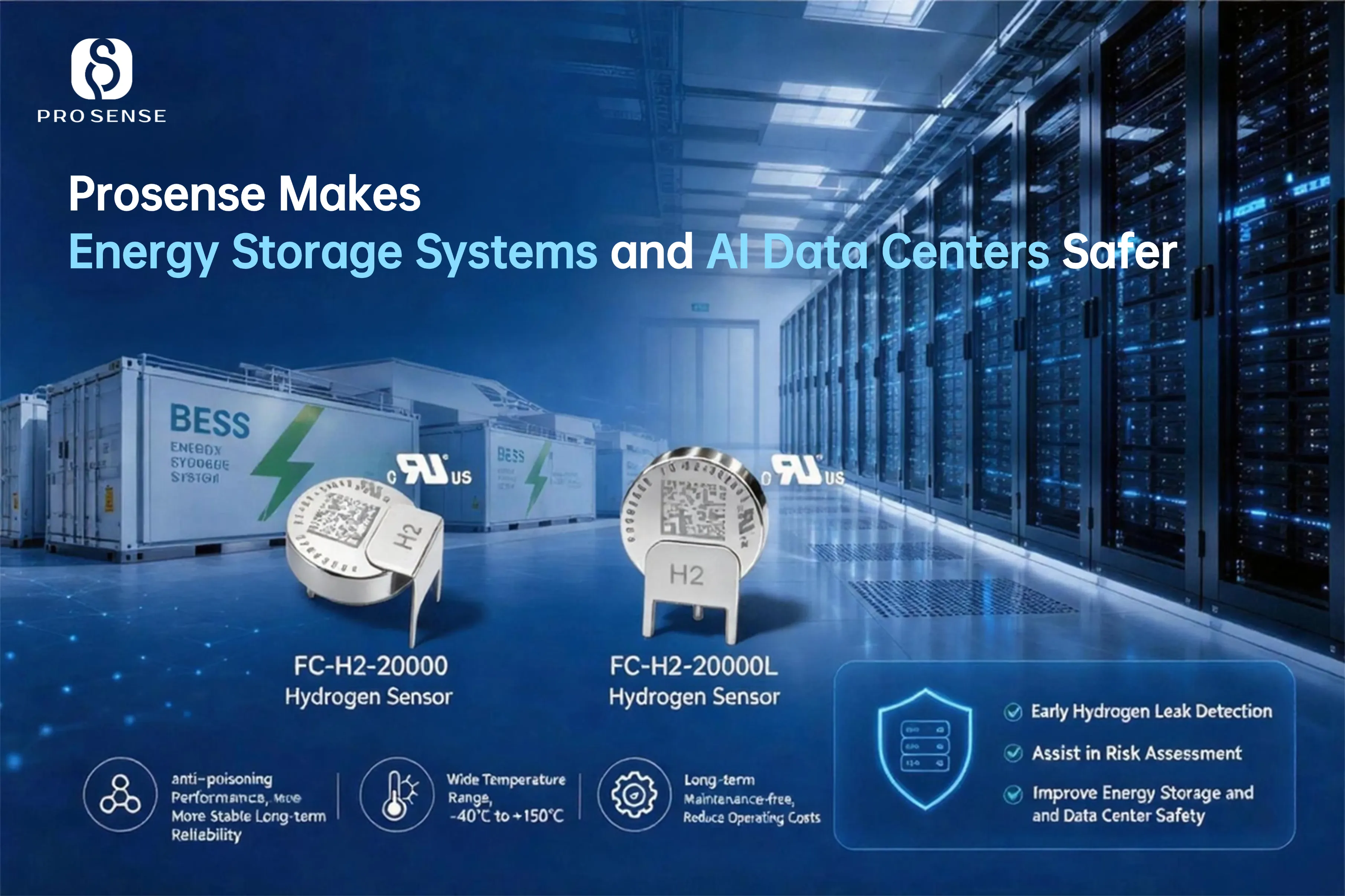
Advanced gas sensing solutions include:
- Low-level and multi-level hydrogen detection with system interlocking: Enables multi-level hydrogen detection at low concentration (500 ppm), 10% LFL (4,000 ppm), and 25% LFL (10,000 ppm), integrated with Battery Management Systems (BMS) and safety control strategies.
- Anti-contamination and anti-silicon poisoning design: Effectively reduces chemical coating of sensing elements by interferents such as VOCs and siloxanes, enhancing hydrogen and CO sensor stability in long-term high-contamination environments.
- High-temperature performance optimization: Meets the continuous detection requirements of energy storage facilities under pre-commissioning enclosed cabinet conditions and high-temperature operation.
- Lifecycle stability enhancement: Extends effective sensor operating life, reducing on-site replacement frequency, maintenance needs, and drift risks.
About Prosense
Prosense is a high-tech enterprise specializing in the R&D and manufacturing of advanced gas sensors, committed to providing global customers with high-performance, high-reliability sensing solutions. The company continues to invest in core technology R&D, tackling critical industry challenges and steadily leading the development direction of gas sensing technologies. With innovative products and exceptional quality, Prosense is progressively emerging as a significant driver and leader in the global gas safety monitoring sector.
Prosense adheres to a full-stack in-house R&D approach, having established a kilogram-level catalyst development base for gas sensors and an automated production and aging/calibration system with an annual output of tens of millions of gas sensors. Its product portfolio covers toxic, hazardous, combustible, explosive, and environmental gas detection applications. Multiple innovative products from Prosense have become core sensing components in vertical markets such as smart fire protection, industrial safety, and energy storage safety.