With the rapid development of AI data centers and battery energy storage systems (BESS), the detection of flammable gases such as hydrogen and carbon monoxide has become a critical component of safety protection for key facilities. However, international standards focus not only on "whether the gas can be detected," but more importantly, on whether the gas concentration can be measured accurately, stably, and reproducibly.
For critical facilities where personnel safety, asset protection, and business continuity are paramount, flammable gas detectors bear the important responsibility of triggering alarms, interlocking ventilation, controlling equipment operation, and supporting emergency decision-making. If the detector cannot accurately reflect the on-site gas concentration, even if it can sense the presence of gas, it still falls short of meeting the requirements for critical industrial safety applications.
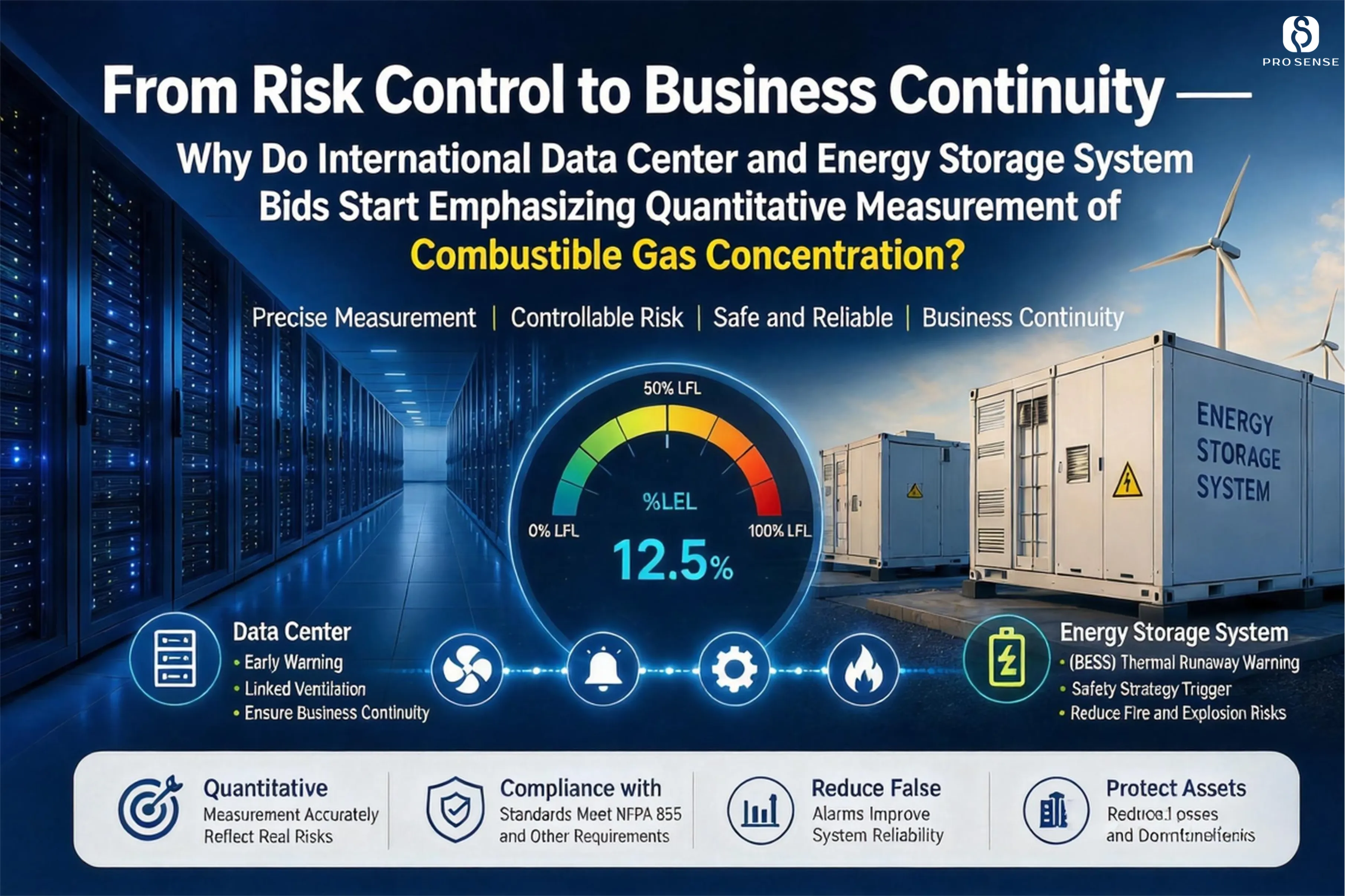
Why Do Data Centers and Lithium-Ion Energy Storage Systems Require "Quantitative Measurement" for Thermal Runaway Management?
From Air Quality Index to Quantitative Flammable Gas Measurement
In the consumer electronics and indoor air quality monitoring sectors, metal oxide semiconductor (MOS/MOX) sensors are commonly used to identify air quality changes, volatile organic compound responses, or environmental anomaly trends. Such products can output an air quality index, relative change values, or comprehensive evaluation results processed through algorithms, but such outputs do not equate to the accurate concentration of a specific flammable gas.
The resistance response of MOS sensors may be simultaneously affected by target gases, other volatile substances, temperature, humidity, oxygen conditions, material aging, and long-term contamination. In environments where multiple gases coexist or where environmental conditions continuously change, the same output signal may correspond to different gas compositions and concentrations. Therefore, MOS solutions that have not undergone sufficient calibration, compensation, and overall product performance verification typically struggle to continuously provide accurate, stable, and traceable ppm or %LFL concentration data in complex industrial environments.
Based on this technical characteristic, some consumer electronics products present monitoring results in the form of air quality levels, indices, or trend changes, rather than directly displaying specific gas concentrations. For air quality management, which is a low-risk application scenario, this approach can satisfy status indication needs. However, for critical facilities such as energy storage systems and data centers, merely outputting trend changes or alarm signals is insufficient to support safety controls based on concentration thresholds.
An "Alarm Signal" Cannot Substitute for "Concentration Data"
Currently, some gas detection products based on MOS/MOX solutions for battery thermal runaway monitoring on the market only provide alarm status based on gas change trends and do not provide real-time gas concentration values. In such cases, owners, insurance companies, engineering consultants, and system integrators find it difficult to independently verify:
- What the actual gas concentration is when an alarm occurs
- Whether the alarm setpoint is consistent with the design threshold
- Whether sensor sensitivity has experienced attenuation or drift
- Whether the detector still possesses effective detection capability after long-term operation
- Whether ventilation, interlock, and fire control systems are activated at the correct concentration conditions
Even if the equipment can generate an alarm signal, this does not prove its concentration measurement accuracy, long-term stability, or alarm threshold reliability. For critical safety systems, unverifiable alarm logic is itself an extremely high safety risk. An increasing number of regulatory bodies, insurance companies, data center owners, and energy storage system manufacturers are becoming aware of the substantial commercial risks and public safety hazards this poses.
NFPA 855 Focuses on Verifiable Risk Control
The current edition of NFPA 855 is the 2026 edition, which covers safety measures for energy storage systems including fire detection, gas detection, ventilation, and explosion control.
In the technical discussion of provisions related to flammable gas detection triggering explosion risk reduction measures, the requirements are based on the percentage of the lower flammable limit as the control basis—for example, initiating corresponding protection measures when gas mixtures or single components do not exceed 10% LFL. Such requirements inherently rely on the quantitative measurement of flammable gas concentration, not merely on determining whether a gas signal has changed.
According to NFPA 855 (2026 edition) requirements:
• The gas detection system shall activate the combustible gas concentration reduction (CCR) system when the combustible gas concentration does not exceed 10% of the lower flammable limit (LFL).
• For hydrogen, this threshold is approximately 4,000 ppm.
For data centers, energy storage systems, petrochemical facilities, and hydrogen infrastructure, the flammable gas detection system is not merely an alarm device—it must also provide reliable decision-making input for automatic control systems.
In data centers and energy storage systems, gas concentration data may be directly used for:
- Activating mechanical ventilation systems
- Controlling HVAC operating modes
- Implementing graded alarms
- Executing equipment interlock controls
- Supporting fire suppression system interlocking
- Providing emergency decision-making input for operations personnel
These control strategies typically correspond to preset concentration thresholds (e.g., ppm or %LEL). Therefore, only detectors that can accurately reflect on-site gas concentrations can ensure that safety strategies are executed as designed.
These safety actions are all built upon accurate, traceable concentration measurement—not simply determining whether "gas is present" or "gas is not present."
Data Centers: Precise Concentration Measurement Supports Continuous Operation
With the adoption of technologies such as lithium-ion UPS, backup batteries, and fuel cells, data centers are extensively deploying hydrogen detection systems.
International engineering designs typically establish graded responses based on different concentration levels, for example:
- Low concentration (500 ppm) and multi-level hydrogen concentration detection alarm strategies
- Ventilation system activation
- High-concentration alarms
- Equipment interlocking or emergency response
If the detector cannot continuously provide accurate concentration data, the system faces two types of risks:
False Alarms
Leading to frequent shutdowns, business interruption, and increased operations and maintenance costs.
Missed Alarms
Failure to timely implement control measures when hazardous gases reach risk levels, increasing safety risks.
Therefore, data centers place greater emphasis on long-term stable quantitative measurement capability, rather than merely the ability to sense the presence of gas.
BESS: Concentration Data Determines Safety Strategy
In battery energy storage systems (BESS), flammable gas detection is used not only to identify thermal runaway but also to activate critical safety strategies.
For example:
- Activating exhaust systems
- Controlling HVAC
- Triggering first-level alarms
- Initiating second-level alarms
- Supporting fire suppression interlocking
These actions are typically executed based on preset concentration thresholds.
If the detector output cannot accurately reflect on-site gas concentrations, it may result in:
- Ventilation starting too early, increasing energy consumption
- Ventilation starting too late, increasing hazard levels
- Alarm point drift
- Safety strategies failing to execute as designed
Therefore, for BESS, quantitative measurement affects not only alarming but directly impacts the entire safety control logic.
From "Detecting Gas" to "Measuring Gas"
With the rapid development of emerging industries such as AI data centers, energy storage systems, and hydrogen energy, the industry's requirements for gas detectors are evolving.
The past focus was:
Whether the flammable gas can be detected.
Today's focus is:
Whether the flammable gas concentration can be measured accurately over the long term and support safety control decisions.
This means that gas detectors are no longer merely alarm devices—they are an integral component of critical facility safety control systems.
Prosense Gas Sensing Solutions Specifically Designed for AI Data Center Lithium-Ion Battery Applications
> As a leading provider of advanced gas sensor R&D and manufacturing, Prosense starts from the real-world complexities of the field and continues to drive technological breakthroughs and international compliance progress in energy storage application scenarios.
>
> The company's hydrogen sensor series products have obtained UL 2075 certification for the US and CAN/ULC 588 certification for Canada, with an operating temperature range covering -40°C to 105°C. They have become industry benchmarks in environmental adaptability, long-term stability, anti-silicon poisoning, and reliability, and have been widely deployed in energy storage system safety monitoring, AI data center infrastructure, and new energy-related applications.
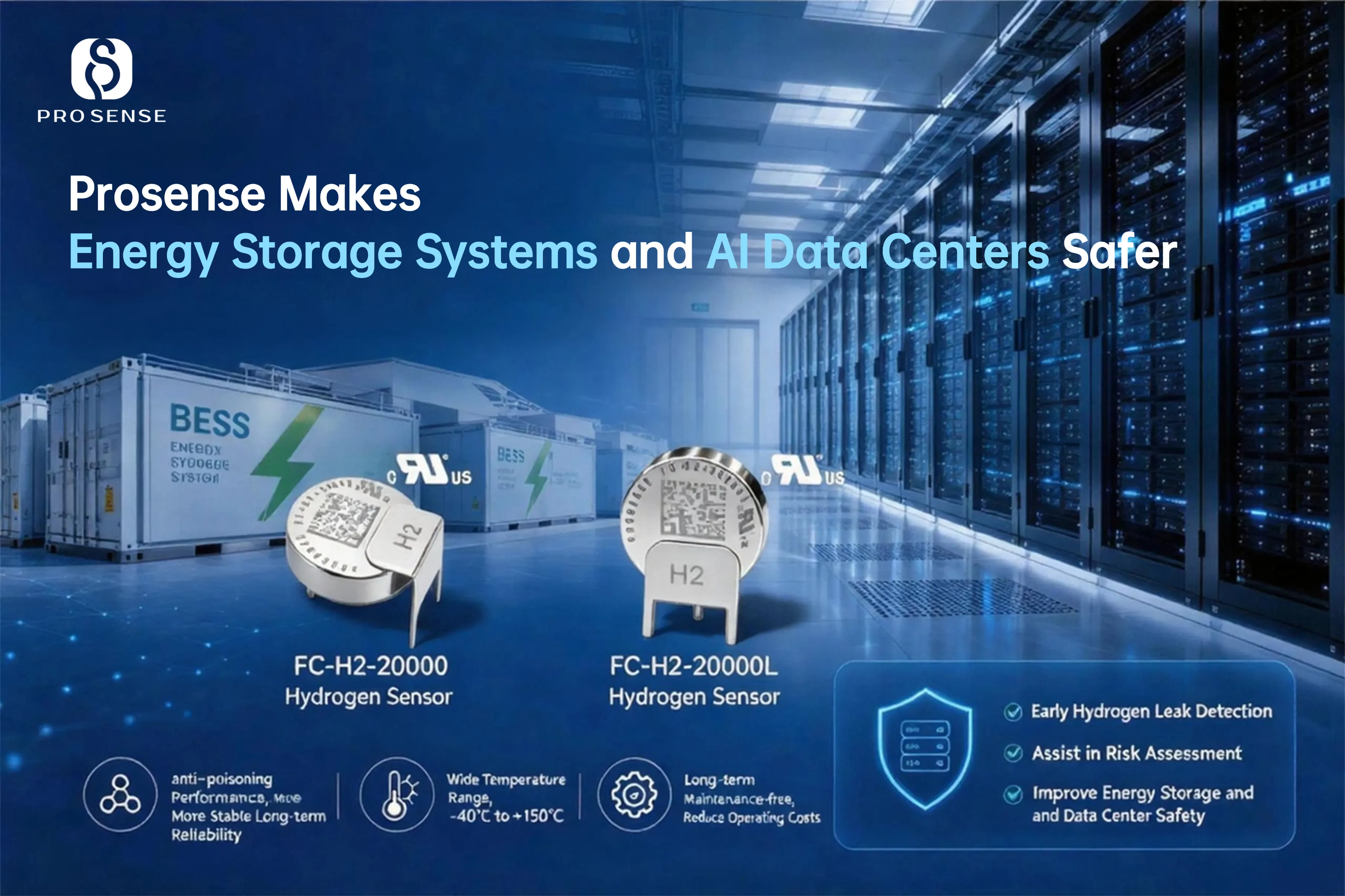
> Advanced gas sensing solutions include:
- Low-level and multi-level hydrogen detection with system interlocking: Enables multi-level hydrogen detection at low concentration (500 ppm), 10% LFL (4,000 ppm), and 25% LFL (10,000 ppm), integrated with Battery Management Systems (BMS) and safety control strategies.
- Anti-contamination and anti-silicon poisoning design: Effectively reduces chemical coating of sensing elements by interferents such as VOCs and siloxanes, enhancing hydrogen and CO sensor stability in long-term high-contamination environments.
- High-temperature performance optimization: Meets the continuous detection requirements of energy storage facilities under pre-commissioning enclosed cabinet conditions and high-temperature operation.
- Lifecycle stability enhancement: Extends effective sensor operating life, reducing on-site replacement frequency, maintenance needs, and drift risks.
About Prosense
Prosense is a high-tech enterprise specializing in the R&D and manufacturing of advanced gas sensors, committed to providing global customers with high-performance, high-reliability sensing solutions. The company continues to invest in core technology R&D, tackling critical industry challenges and steadily leading the development direction of gas sensing technologies. With innovative products and exceptional quality, Prosense is progressively emerging as a significant driver and leader in the global gas safety monitoring sector.
Prosense adheres to a full-stack in-house R&D approach, having established a kilogram-level catalyst development base for gas sensors and an automated production and aging/calibration system with an annual output of tens of millions of gas sensors. Its product portfolio covers toxic, hazardous, combustible, explosive, and environmental gas detection applications. Multiple innovative products from Prosense have become core sensing components in vertical markets such as smart fire protection, industrial safety, and energy storage safety.