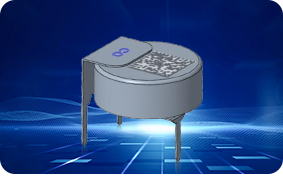
ProSense was invited to attend the BSI Group Standard Technology Seminar and deliver a keynote speech
Against the backdrop of the continuous evolution of global residential safety standards and increasingly complex terminal application scenarios, standard driven technological innovation and systematic risk management are becoming the core path for upgrading the carbon monoxide (CO) alarm industry.
As a professional manufacturer in the field of advanced gas sensing technology, ProSense is invited to attend a special seminar on fire alarms and detectors hosted by the international standard organization BSI Group, and deliver a technical speech entitled "From Standards to Applications: Selection and Full Life Cycle Risk Management of Carbon Monoxide Sensing Technology for Residential and RV Buildings in Europe and America". Together with local alarm manufacturers, we will explore the latest trends and practical paths in household carbon monoxide safety detection technology.
This speech focuses on the application scenarios of residential and RV (RV) in Europe and America, from interpreting market regulations, comparing sensing technology routes, to whole life cycle reliability management. It systematically elaborates on how to improve the long-term safety performance and market compliance of products through scientific selection and risk control.
Swipe left and right to view more
Market Trends and Regulatory Requirements for Carbon Monoxide Detectors in Residential and RV Markets in Europe and America
With the continuous strengthening of residential safety regulations in North America and Europe, carbon monoxide alarms are shifting from a "compliance driven" approach to a "long-term reliability driven" approach.
In complex application environments such as residential and RV, CO alarms face more stringent challenges:
The potential risk increase brought by the coexistence of confined spaces and combustion equipment
Significant fluctuations in temperature and humidity affect the long-term stability of the sensor
Long life operation requirements (10th grade product cycle) have become mainstream in the industry
Regulations and certification systems are constantly upgrading, with higher requirements for consistency and reliability
In this context, international standard systems represented by BSI Group and other standard organizations are continuously promoting the upgrade from "product compliance testing" to "full lifecycle risk management".
Comparison and Application Selection of Carbon Monoxide Sensing Technology Routes
At the core component level of CO alarm, the choice of sensor technology route directly determines the performance boundary and long-term reliability performance of the whole machine.
The current mainstream technological routes include:
Fixed point electrolytic carbon monoxide sensing technology
Fuel cell based water-based electrochemical sensing technology
ProSense sensing fuel cell based non-aqueous electrochemical sensing technology
There are significant differences in structural design, reaction mechanism, and environmental adaptability among different technological paths
1. Fixed point electrolytic carbon monoxide sensing technology
·Widely used in the industrial field
·Service life of about 2 years
·Regular calibration is necessary
·Narrow temperature range
2. Fuel cell based water-based electrochemical sensing technology
·There is a risk of freezing in low-temperature environments
·Long term stability is greatly affected by changes in the water system
·Easy to suffer from silicon poisoning
·Reliability constraints exist in specific application scenarios
3. ProSense Fuel Cell Non Water Chemical Sensing Technology
·Wide temperature range of operation
·No risk of low-temperature freezing and high-temperature dehydration
·Has excellent resistance to silicon poisoning and VOC interference
·Suitable for 10-year long-life residential and RV application scenarios
In the European and American residential and RV markets, sensor selection is no longer only focused on "initial performance indicators", but also pays more attention to:
Long term drift control capability+environmental adaptability+controllable failure risk
The selection of CO sensors should start from a system level perspective, taking into account application scenarios, certification requirements, and lifecycle reliability, rather than comparing individual performance parameters.
Full lifecycle reliability and risk management
As the product lifecycle extends to 10 years or even longer, the reliability management of carbon monoxide sensors is becoming a core issue in the industry.
1. Failure modes and systemic risks
During long-term operation, CO sensors may face various failure mechanisms, including:
·Sensitivity attenuation and drift accumulation
·Electrolyte drying up or performance degradation
·Electrode pollution and decreased catalytic activity
·Aging of structural materials
These factors may ultimately translate into alarm system level risks, including false positives and false negatives.
2. Analysis of Environmental Stress Effects
In real application environments, sensors need to withstand complex environmental stresses for a long time:
·High and low temperature cycling: affecting the stability of electrochemical reactions
·High humidity environment: causing changes in material properties
·Silicon poisoning: reducing catalytic activity
·Volatile organic compound (VOC) interference: affecting selectivity and stability
In RV and residential applications, these risks are further amplified due to stronger spatial confinement.
3. Long term stability and lifespan management
The reliability management of CO sensors should run through the entire product lifecycle, including:
·Design phase: Material system and structural reliability design
·Verification phase: Accelerated life and environmental stress testing
·Production stage: Consistency control and batch stability management
·Application stage: Long term drift monitoring and failure prediction model
Only by building an end-to-end risk management system can we truly achieve a leap from "passing standards" to "continuous security".
ProSense FC-CO-5000 and FC-CO-5000-0X: A Unified Sensing Platform Covering Multiple Scenarios
The FC-CO-5000 and FC-CO-5000-0X series carbon monoxide sensors launched by ProSense, relying on independent research and development capabilities, are currently the only CO sensor solutions in the industry that meet UL certification requirements for residential, RV, and yacht application scenarios.
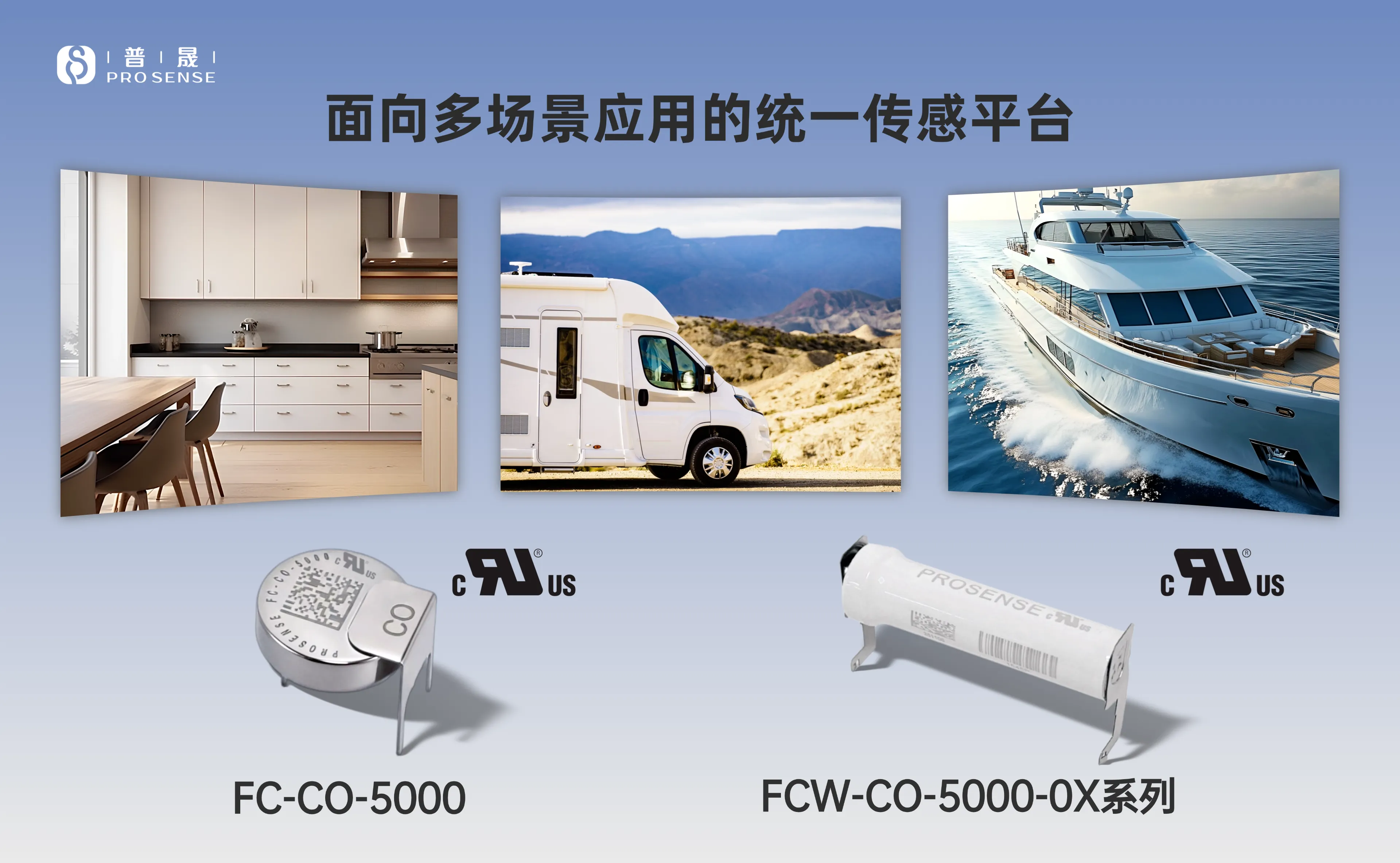
In the design phase, the product is systematically planned around multi application scenario compliance and long-term reliable operation, fully considering the comprehensive requirements of temperature adaptability, stability, and consistency of sensors under different environmental conditions. This helps the whole machine manufacturer build a product portfolio covering multiple markets on a single sensing platform.
By adopting FC-CO-5000 and FC-CO-5000-0X, complete machine manufacturers can reduce the design and certification complexity caused by differences in application scenarios while meeting the requirements of UL 2034 (5th edition) and CSA 6.19-17 standards.
Market oriented value
Unified platform: One sensor covers multiple application scenarios, simplifying product portfolio
Compliance guarantee: supporting certification needs in the mainstream residential, RV, and yacht markets in North America
Reliable operation: Adapt to complex environmental conditions and enhance the long-term stability of end products
Accelerating time to market: reducing the time and cost pressure of repeated testing and re certification
From Technology to Standards: Compliance Capability Originates from Deep Participation in Standards
In addition to its engineering capabilities at the product level, Pusheng Sensing actively participates in the construction of the North American gas safety related standard system and is the only member of the technical committees authorized by UL 2075, UL 2034, and UL 2201 in the Asia region of ULSE. Through long-term participation in standard discussions and technical reviews, Pusheng Sensing maintains a continuous and in-depth understanding of the safety logic, testing boundaries, and future evolution directions behind standard terms.
This role enables Pusheng Sensing to advance standard requirements to the product design and verification stage, and provide feedback on actual engineering experience to the standard system, helping customers form clear judgments on compliance paths in the early stages of product development, reducing repeated testing and uncertainty.
The core value created for alarm manufacturers
Expected compliance: Based on mature standard understanding and certification experience, reduce market access risks in North America
Platform based design: Series sensors cover multiple application scenarios, simplifying product line layout
Engineering reliability: To cope with complex environmental conditions and improve the long-term stability of end products
Efficiency improvement in listing: reducing the time and cost pressure caused by repeated testing and re certification
Conclusion
With the continuous evolution of the global residential safety standard system, the carbon monoxide alarm industry is entering a new stage centered on "long-term reliability".
In this trend, sensors are no longer just a single detection element, but a key foundational technology that determines the safety boundary of the entire machine.
ProSense will continue to focus on advanced gas sensing technology innovation, and work together with global standard organizations, alarm manufacturers, and industry partners to promote the construction of a higher safety level product system. Based on standards and guided by applications, we will build a carbon monoxide safety monitoring and protection function that covers the entire life cycle.
About ProSense
ProSense is a high-tech enterprise dedicated to the research and manufacturing of advanced gas sensors, committed to providing high-performance and high reliability sensing solutions for global customers. The company continues to invest in core technology research and development, overcome key pain points in the industry, and continuously lead the development direction of gas sensing technology. With innovative products and excellent quality, ProSense is gradually growing into an important promoter and leader in the global gas safety monitoring field.
ProSense adheres to the full stack self-developed technology route, and has established a kilogram level gas sensor catalyst research and development base and an automated production aging calibration system for millions of gas sensors per year. Its product line covers the fields of toxic and harmful, flammable and explosive, and environmental gas detection; ProSense multiple innovative products have become core sensing components in vertical fields such as smart firefighting, industrial testing, and energy storage safety.